Neanderthals
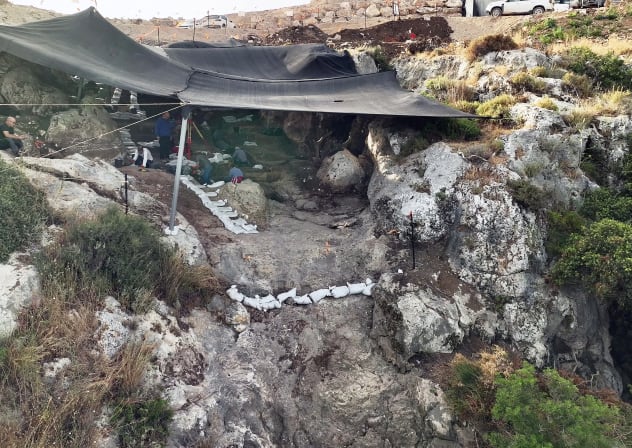
WATCH: A Paleolithic time capsule: Rare prehistoric cave discovered near highway outside of Haifa
The cave dates back to 400,000 and 250,000 years ago, to the time of the Acheulo-Yabrudian culture – a collection of archaeological cultures in the Levant from the end of the Lower Paleolithic era.

Neanderthals' ancient toolkit included hammers, blades made from rhino teeth, study finds

Neanderthal tooth from Siberian cave shows signs of earliest-known invasive dental surgery - study

Extremely painful: Evidence suggests Neanderthals performed root canals 59,000 years ago
Iran may be a hotspot of Neanderthal archaeology - study
Researchers used geographical data systems, with bio-geographical data inputs, to uncover routes that Neanderthals would have likely taken.

Neanderthals hunted, butchered elephants, study reveals
The evidence comes from the Neumark-Nord 1 site near Halle, Germany, where 3,122 bones, tusks, and teeth have been found.

Prehistoric chefs experimented with flavors and new recipes, archaeologists say
Scientists now have the proof they need to definitively say that ancient humans and neanderthals may have shared recipes among their own.
UK Boxgrove fossils highlight complexities of human evolution in new study
A comparison between the UK's Boxgrove fossils and the Sima de Los Huesos in Spain has led to new understandings of the links between some of Europe's earliest humans.

Ancient DNA gives rare insight into how Neanderthal families lived
The findings of this peer-reviewed study shed light on the social organization and structure of Neanderthal communities and families, how they lived and who moved around.

Neanderthals, early humans overlapped in Europe for thousands of years - study
A new study claims there was co-existence between two species of man over a duration of at least 1,400 to 2,900 years.
Ancient DNA from China suggests Native Americans’ Asian roots
The research behind this discovery started over three decades ago, when a group of Chinese archaeologists discovered a large set of bones in southern China’s Yunnan Province.

The Neanderthal lifestyle: archeological insights from Valencia
The Los Aljezares open-air site is "rich in lithic, faunal and archaeobotanical materials, and well-dated in time."
Analysis of 5,000-year-old DNA could help solve mystery of genetic changes in Europe
Two tall skeletons were discovered in Serbia, and their extracted DNA might help to shed light on the mystery of genetic changes that took place in Europe five thousand years ago.

Neanderthal genetic variant raises risk for COVID-19, protects from HIV - study
"Bad news if a person contracts COVID-19, good news because it offers protection against getting infected with HIV."
