Here’s something you don’t see every day in diplomacy: the prime minister of one country saying he visited another country, only for that country’s foreign ministry to deny the visit ever took place.
Yet that is exactly what happened last week when the United Arab Emirates issued a statement rejecting claims made a day earlier by Prime Minister Benjamin Netanyahu’s office that he had secretly visited the UAE and met with its leader, Sheik Mohammed bin Zayed, and that the meeting had resulted in a “historic breakthrough” in relations between the two countries.
The UAE foreign ministry called the Prime Minister’s Office statement “entirely unfounded,” adding that relations between the two states “are public” and “not based on non-transparent or unofficial arrangements.”
Coming so soon after reports that Israel sent an Iron Dome battery to the UAE during the war with Iran, along with personnel to operate it, and amid reports that the heads of both the Mossad and the Shin Bet (Israel Security Agency) had visited Abu Dhabi in recent weeks for high-level coordination, the episode of the Netanyahu – or non-Netanyahu – meeting left some scratching their heads.
It was a fly in what otherwise appeared to be the heady perfume of blossoming Israel-UAE ties.
And it was a fly spawned in domestic Israeli politics.
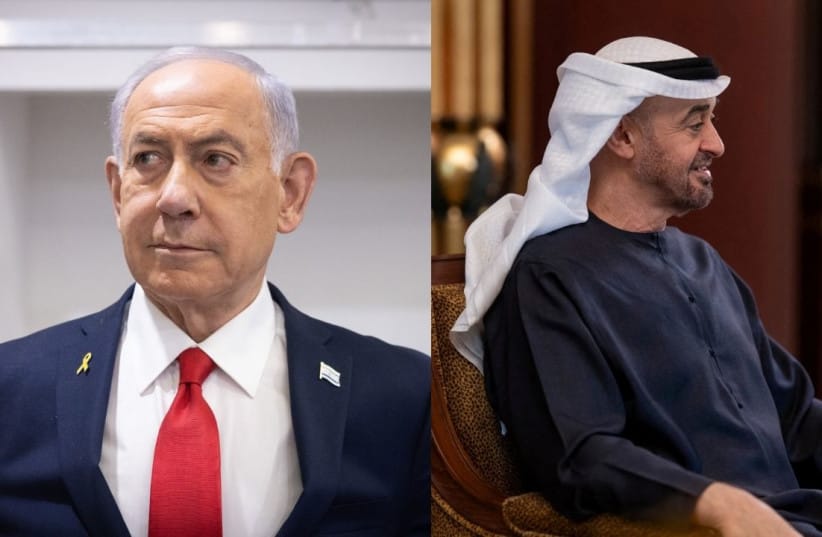
The UAE did not take kindly to being a player in an Israeli political game
According to a Channel 12 report, Netanyahu announced the visit to avoid being upstaged by former prime minister Naftali Bennett, who was reportedly scheduled to visit the kingdom the next day.
What’s the problem? The Emirates did not take kindly to being a bit player in an Israeli political game. It wants to manage the optics of this rapidly expanding relationship and not be turned into a political trophy for Netanyahu.
But the political theater surrounding the disclosure obscured a much larger story: despite occasional hiccups over optics and timing, relations between the two countries are deepening dramatically as a result of the war with Iran.
The relationship between Israel and the UAE has moved well beyond the symbolism of the Abraham Accords. What began in 2020 as a breakthrough in normalization with Arab states, even though the Palestinian issue has not been resolved, is, under the pressure of the wars with Iran - both last year’s and the current conflict - evolving into something far more consequential: a strategic partnership shaped by security coordination, intelligence sharing, air defense cooperation, and even discussions about the region’s postwar architecture.
CNN quoted Yoel Guzansky, a fellow at the Institute for National Security Studies, as saying that the UAE is one of the countries closest to Israel globally. “It’s not just security. It’s tourism, science, investment, trade. There is no Arab country closer.”
This closeness also goes a long way toward explaining why the UAE was hit so hard by Iran during the recent war, absorbing more ballistic missiles and drone attacks than any other country in the region, including Israel.
While the relationship may not be only about security, security is clearly its beating heart.
Middle East Eye, a London-based digital platform that is decidedly pro-Palestinian and sharply critical of Israel, reported this week that Israel and the UAE have established a fund to jointly acquire and develop new weapons systems as part of a new defense partnership, and that this was the agreement cemented by Netanyahu’s visit to the Gulf state.
Guzansky told the website that this type of venture is a logical next step in the relationship.
“Israel will need UAE money. We have the technology, but we lack the resources. The UAE has the resources, but lacks the technology,” he said.
The growing closeness of the relationship, evident in talk of a joint fund, made the Emirati irritation over Netanyahu’s disclosure noteworthy but not alarming. It also points to a larger shift in UAE strategy that the war with Iran has accelerated.
Abu Dhabi is increasingly acting less like a conventional member of an Arab consensus and more like a state determined to chart its own course, even when that means breaking with the other Gulf countries.
Its decision last month to leave OPEC after some 60 years may have been framed primarily as an economic move, but it also reflected something political: a willingness to step outside existing structures and define its interests with far greater freedom.
In that sense, the deepening relationship with Israel is not just about shared threat perceptions or military utility. It is also about autonomy and independence.
The UAE wants Israel’s technology, intelligence, and the practical benefits of closer security coordination. But it also wants to remain in control of the relationship, which is precisely why the Netanyahu episode seemed to irritate it.
The issue was not that the relationship is fragile. It was that Abu Dhabi does not want to be cast as a prop in Israeli domestic politics, or folded into a narrative of a new Israeli-led regional order it does not itself define.
Cinzia Bianco, a visiting fellow at the European Council on Foreign Relations who specializes in the Gulf states, framed the UAE’s decision to leave OPEC as an expression of a strategic shift accelerated by the Iran war and an indication that the UAE is now “increasingly unbound by Arab and Muslim consensus politics or inherited institutions such as OPEC.”
One of the reasons for this willingness to go it alone is deep disappointment in the Arab world’s response to Iran’s attacks on it.
“Israel’s counter-drone lasers and its Iron Dome system were crucial in intercepting over 95% of Iranian projectiles targeting the UAE,” she wrote. “For Abu Dhabi, this stands in stark contrast to what many Emirati officials see as a complete lack of tangible Arab solidarity during the crisis.”
Riyadh may well welcome seeing Iran weakened
Tareq al-Otaiba, a former official at the UAE’s national security council, wrote in an article for the Arab Gulf States Institute that the current crisis, which he dubbed the region’s most significant since the 1990 Iraqi invasion of Kuwait, “is not only testing the Gulf’s air defenses, it is exposing the hollowness of Arab solidarity.
“In the face of Iranian aggression, several states have stepped up to provide real assistance to the UAE. Primarily, the United States and Israel have proved to be true allies by offering support through extensive military aid, intelligence sharing, and diplomatic backing. The same support has not come from the Arab world.”
While the UAE appears to be moving steadily closer to Israel as a practical security partner, Saudi Arabia is not. Rather, it is charting a different course.
Riyadh may well welcome seeing Iran weakened and its regional reach curtailed, but it is also wary of any outcome that leaves Israel emerging from the conflict as the Middle East’s dominant power.
Witness what happened after the 12-Day War last June when the US and Israel significantly degraded Iran’s nuclear capabilities. One might have thought that this would have led to a Saudi-Israel opening. It didn’t. In fact, there was an uptick in anti-Israel and even antisemitic rhetoric from Saudi officials, religious figures, and the media.
How to explain this phenomenon? While Saudi Arabia welcomes the weakening of Iran and thwarting its plans to become the Middle East hegemon, it does not want to see Israel’s power in the region increase, nor does it want to do anything that would serve to increase the country’s reach, which normalizing ties with it would necessarily do.
So while the UAE is forging closer ties with Israel as a bulwark against Iranian aggression in the future, Saudi Arabia is looking in other directions – strengthening its ties with Pakistan and Turkey. The three countries drafted a trilateral defense agreement in January, signaling the emergence of a new Sunni axis in the region.
Reuters reported this week that Pakistan has deployed some 8,000 troops, a squadron of fighter jets, drone units, and a Chinese-operated air defense system to Saudi Arabia as part of a confidential mutual defense pact signed late last year.
So, rather than lean toward Israel, this is all an indication of how Saudi Arabia is looking elsewhere for security guarantees.
The UAE is moving toward deeper operational coordination with Israel, while Saudi Arabia is maneuvering to preserve a regional balance in which neither Tehran nor Jerusalem becomes too powerful. The way for it to do that is to look to Ankara and Islamabad for defense support, not Jerusalem – something that would be highly unpopular on the Saudi street.
The current war, as a result, is not only degrading Iran’s power; it is also exposing the region’s new strategic fault line.
The UAE is increasingly turning to Israel as a security partner that can deliver when it matters. Saudi Arabia, meanwhile, is hedging – looking to Pakistan and Turkey rather than Jerusalem because it wants Iran weakened, but not at the price of seeing Israel emerge as the region’s new heavyweight.
And that growing split – between the UAE moving closer to Israel, and Saudi Arabia building alternative security alliances with countries like Pakistan and Turkey – may become one of the defining fault lines of the postwar Middle East.