Telescope
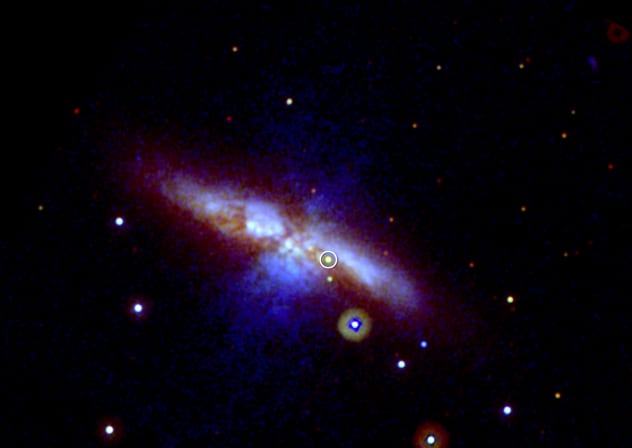
NASA observatory falls out of orbit, burns in atmosphere after 22 years of studying the cosmos
The 3,200-pound Swift aircraft most likely burned up after re-entry, although NASA said some components may have survived.

NASA launches powerful Roman Space Telescope, a spy satellite turned to the stars

Habitable worlds may be far more common than thought, Israeli study says

No danger, says NASA: Airplane-sized asteroid buzzed Earth at 28,000 mph
James Webb telescope reveals oxygen in galaxy from 13.4 billion years ago
Light from JADES-GS-z14-0 has taken 13.4 billion years to reach Earth, revealing a chemically mature galaxy when the universe was less than 300 million years old.

Underwater Mediterranean Sea telescope records most energetic neutrino ever observed
The KM3NeT telescope comprises two detectors, ARCA and ORCA, utilizing seawater to capture Cherenkov light—a bluish glow produced when neutrinos interact with water molecules.

Euclid telescope discovers rare Einstein ring around nearby galaxy NGC 6505
Gravitational lensing occurs when the gravity of a massive object, like a galaxy, warps the fabric of spacetime, bending the light from a more distant background object.

Webb Telescope reveals intricate structures in Cassiopeia A supernova
A light echo is created when a star explodes or erupts, flashing light into surrounding clumps of dust and causing them to shine in an ever-expanding pattern.

Infrared telescopes discover hundreds of previously undetected supermassive black holes
Using IRAS and NuSTAR telescopes, scientists identify hundreds of obscured black holes hidden behind gas and dust.

Webb telescope captures 'stunning' images of 19 spiral galaxies
The images let scientists resolve the structure of the clouds of dust and gas from which stars and planets form at a high level of detail in galaxies considered galactic satellites of the Milky Way.

Saturn visible in Israel's night sky at its brightest
While the rings won't be visible to the naked eye any small backyard telescope should show the rings, which will appear as bright oval-shaped disks.

NASA’s Webb Telescope captures the dying star ‘Ring Nebula’ in new detail
The images were captured by the James Webb Space Telescope, which was developed to view objects too old, distant, or faint for the Hubble Telescope.

Hubble telescope captures galaxy clusters merging
Gravitational lensing has the practical effect of a magnifying glass, microscope, or binoculars, and enables scientists to observe celestial bodies that would otherwise be too distant to discern.

Direct imaging unveils 'Jupiter's younger sibling': Landmark in exoplanet exploration
This method could revolutionize the way we discover extrasolar planets, especially those that are challenging to detect due to their distance, mass, or orientation relative to Earth.
