Romans
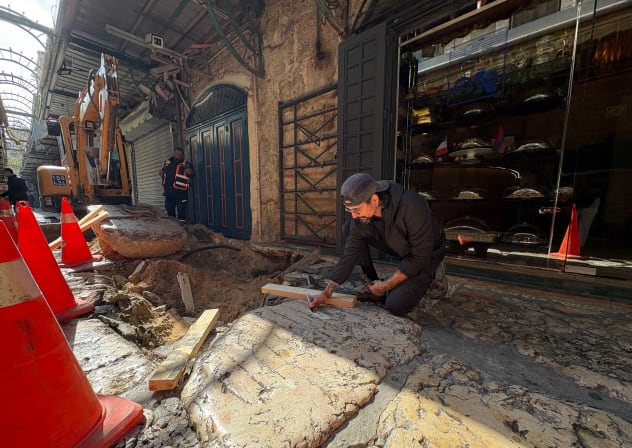
In historic first, Old City of Jerusalem’s Roman-era street to be made wheelchair accessible
Work on the Roman pavement of the Christian Quarter Road first began in 1977, carried out by the Jerusalem Municipality and PAMI as part of infrastructure improvements in the Old City.
Ancient Bar Kokhba revolt-era hiding tunnels, Byzantine church reopened to public in Israel
UK technician successfully recreates multi-colored Roman glass, cracking 1,600-year-old mystery
Skeleton found in Roman sarcophagus at Westminster Abbey may have belonged to medieval monk
Plaster-making technique attributed to Romans used at Motza some 8,000 years earlier, study shows
"The Pre-Pottery Neolithic B residents of Motza were surprisingly able to differentiate calcite and dolomite stones and used both in their plaster making," the study said.

‘Lexden Lady,’ wealthy Roman woman buried in lead coffin, goes on display in UK
Her exact burial date is unclear, according to the Trust’s statement, but it was likely during the late Roman period - lasting from approximately the late 3rd century to early 5th century CE.

Pompeii victim revealed to be a doctor fleeing Vesuvius’ eruption over 60 years after discovery
The doctor’s identity followed new analysis of archaeological finds kept in the park’s storage warehouses - including a small case hidden within the cast of one of the victims from the garden.

Collection of Greek, Roman, Byzantine artifacts discovered in neighborhood of Egypt’s Alexandria
Professor Ibrahim Mustafa, head of the archaeological mission and director of the Central District, stated that initial restoration work for the artifacts has already started.

Italian archaeologists use AI to generate image of Pompeii victim for first time
It is based on the recent discovery of the remains of a male adult, just outside one of the southern gates of the city, lying next to a terracotta mortar that he presumably used as protection.

How archaeologists used technology to rediscover ancient Egyptian city on the Nile Delta - study
The site holds three prominent mounds, known as Koms A, B, and C, with Kom C selected for investigation due to its history spanning the Predynastic period through the Early Islamic era.

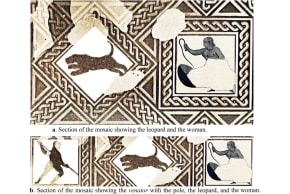
Lost mosaic shows first visual depiction of women fighting beasts in Roman arenas - study
The mosaic, recovered in 1860s Reims, France and dated to the third century CE, shows about 35 different gladiatorial and hunting scenes, each surrounded by diamond or square-shaped decorations.
Roman fort found north of Hadrian’s Wall may have been used to defend against unconquered Scotland
According to GUARD, the fort was constructed on high ground along the Antonine Wall, granting it an unobstructed view of the surrounding area, and intervisible with a much larger fort to the west.

Children buried in 'adult warrior' bronze belts discovered in 2,500-year-old tomb in Italy
A total of 34 burials dating between the 4th and 3rd centuries BCE were discovered, the Superintendency shared, half of which belonged to children between the ages of two and 10.

Archaeologists find evidence of postmortem 'crucifixion' in Roman burials
Archaeologists report nails driven into remains and deliberately scattered in tombs, indicating non-accidental postmortem 'crucifixion' as part of a dark funerary ceremony.
