Fossil
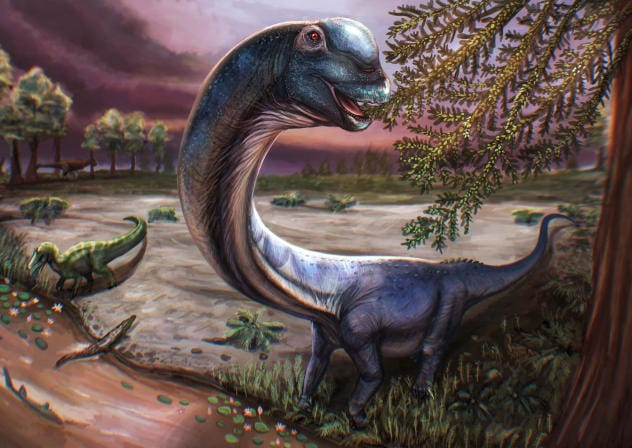
Scientists unearth fossil of Southeast Asia's largest dinosaur in Thailand
Nagatitan lived at a time when Earth's atmospheric carbon dioxide levels were rising, coinciding with high global temperatures.

Newly discovered fossil challenges idea of ape origins in east Africa - study

Stone handaxes found in Galilee show early humans valued aesthetics of their tools - study

Fossils of a new species of huge dinosaur Spinosaurus unearthed in Niger
Megalodon shark may have reached 80 feet, new study finds
Megalodon sharks roamed the seas between 20 million and 3.6 million years ago.

New fossils reveal Paranthropus robustus walked upright like modern humans
Researcher Cazenave emphasizes, "these fossils show that this species, comparable to modern humans, walked upright but was extremely small in size."

Meet 'Pink': The 1.4-million-year-old face changing Europe's human story
Researchers say the fossil suggests a previously unknown human species lived in Europe over one million years ago.

Discovering the leaf-eating, tree-clinging mammal of the Paleocene
Skeleton shows Mixodectes pungens lived in trees and primarily ate leaves during the Paleocene epoch, highlighting its unique ecological niche after the dinosaurs.

Meet Chadititan calvoi: The Graceful Titanosaur Newly Unveiled in Patagonia
Paleontologists uncovered fossils of a new species of long-necked, plant-eating dinosaur named Chadititan calvoi in northern Patagonia.

Scotland's most complete dinosaur fossil extracted from Isle of Skye cliff
Bone analysis reveals the Elgol dinosaur is a 166-million-year-old ornithopod.

Scientists discover six new fossil eggshell types in Utah's Mussentuchit Member
Study provides earliest evidence of multiple oviraptorosaurs co-existing in North America.

125-million-year-old, palm-sized scorpion fossil discovered in China
The fossil has been named Jeholia longchengi after its discovery site in the Jehol Biota of Longcheng District in Liaoning Province.

Zealandia’s bee: 14.6-million-year bee fossil found in New Zealand's Hindon Maar
Paleontologists believe that Leioproctus barrydonovani inhabited broadleaf forests surrounding a Miocene maar lake—a crater formed by a volcanic explosion.

778,000-year-old animal tracks found on Isla de las Palomas
Over 600 fossilized footprints of species like elephants and giraffes suggest Tarifa was a transit corridor in the Early Pleistocene.
