Excavations
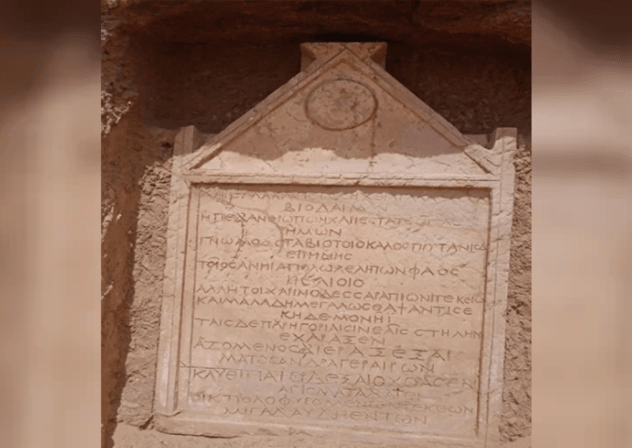
Ancient Greek elegy dedicated to judge found in ancient Egyptian tomb sealed with protection spells
Its 19-lines of ancient Greek text is written in red ink, dedicated to a person named "Pesikhtis," who, according to preliminary study, may have held the position of judge.

Excavations near ancient Turkish port may have found Alexander the Great’s soldiers tombs - report

Noah’s Ark? Researchers claim radar scan reveals 'man-made' structure at Turkey site

Ancient Egyptian fortress uncovers soldiers’ homes, royal inscriptions, and horse burial
Sunken secrets: earliest iron-age cargoes in Israel’s Tantura lagoon
Research in Antiquity identifies the three wrecks as Israel’s earliest submerged cargoes, proving coastal trade survived long after the late bronze age collapse.

Excavation uncovers 1,300-year-old breads stamped with Christ the Sower
Experts suggest these finds may be 'communion bread' used in early Christian rituals, revealing both ritual customs and the symbolic integration of spirituality into everyday life.

Göbeklitepe Discovery: Could These Quadrangular Plans Be Residences?
"In just a few weeks of work, we identified the existence, locations, and densities of not only large monumental buildings and public structures but also residences," said the excavation director.

Groundbreaking discovery: Karahan Tepe reveals 12,000-year-old human face
A T-shaped stele bearing a human face, unearthed during excavations near Göbekli Tepe, is characterized by distinctive features such as sharp contours, deep eye sockets, and a broad-shaped nose.

From crossbow bolts to 13th-century sandals: The trove found in vulture nests
Among the 2,483 objects recovered, researchers catalogued 226 human made artifacts including a thirteenth century esparto sandal, a crossbow arrow and a 630 year old piece of decorated leather.

Relatives weep for scores of missing children after deadly Indonesia school collapse
Parents search desperately as 91 remain missing after an Islamic boarding school in East Java collapsed during prayers, trapping scores under concrete.

Israel Antiquities Authority uncovers 5,500-year-old ‘Canaanite blade factory’ at Nahal Qomem
Dr. Jacob Vardi says the early bronze age site shows 'only exceptional individuals knew how to produce the Canaanite blades,' revealing a complex, specialized society.

Three Roman-Era mansions found on Tralleis’ ancient shopping street
"We understood that metal production was carried out in the 4th and 5th centuries AD," says Prof. dr. Çekilmez.

Only the third of its kind: Early Bronze Age gold brooch from 2,500 BCE changes Troy’s story
The 4,500-year-old ring brooch, the best preserved of three worldwide, conclusively dates Troy II to about 2500 BCE and will soon be displayed at the Troy Museum.

Bible Scenes of Abraham and Isaac revealed after church’s 16-year restoration
Restored wall paintings now show Abraham’s sacrifice of Isaac and scenes of the devil’s defeat, protected under a new roof.
