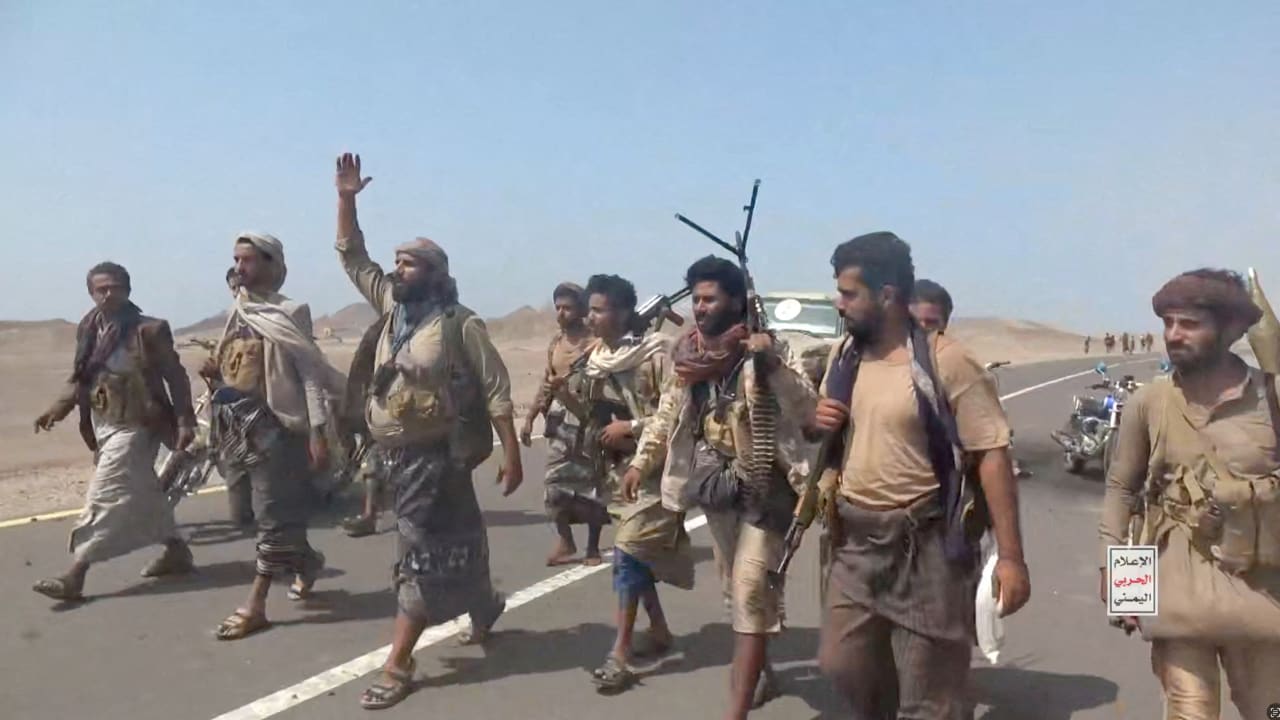
The Houthis, the Iranian-backed group in Yemen, have made new advances in the country after the Yemeni government claimed its “redeployed” forces near Bab al-Mandeb. The Houthis made a rapid advance and captured the area in September. However, they were then pushed back by the Yemeni government.
Now, it appears this seesaw desert battle has swung back in the Houthis' favor.
Arab News in Saudi Arabia reports that “a source in the Yemeni presidency told Asharq Al-Awsat that the Southern Armed Forces' redeployment around Bab Al-Mandeb and Dhubab was a calculated military move aimed at achieving three main objectives: protecting Aden, reinforcing the fronts in Lahj and creating the conditions to break the siege of Taiz and liberate the province.”
The Yemeni government, which is backed by Saudi Arabia but is relatively weak and only controls part of Yemen, is portraying the movement of its forces as a “redeployment from the vicinity of Bab Al-Mandeb and Dhubab,” and they are saying it “should not be interpreted as a withdrawal in the military sense, but rather as a move to redistribute troops and reinforce positions with greater influence over the course of the fighting.”
This could be crafty language. The Yemeni government is suffering setbacks. It has to deal with the fact that the Houthis are laying siege to the city of Taiz and the Houthis have tightened their grip in the highlands above Aden.

Chaos on the frontlines
A year ago, that area was controlled by the UAE-backed Southern Transitional Council. A controversy with Saudi Arabia in November and December led the STC to hand over areas to the Yemeni government. This has led to some chaos on the frontline.
The Houthis control the mountains and highlands. This puts the government in a difficult position on the coast.
Arab News says that the government has “described the redeployment as a calculated military move intended to protect Aden, strengthen the fronts in Lahj and create the conditions for lifting the siege of Taiz.”
It goes on to say that “Yemeni Armed Forces spokesman Col. Majed Abdullah Al-Nuzaily said the Southern Forces' commitment to breaking the siege of Taiz represented a national stance at a particularly sensitive stage, stressing that protecting the capital, Aden, and lifting the siege of Taiz were national and moral responsibilities aimed at confronting the threat posed by Houthi militia violations.”
The major concern is that the Houthis will advance along the ridgelines overlooking the coastal plain near Aden.
“Control of those heights, he explained, would allow the occupying force to threaten the coastline and outflank troops stationed along it,” Arab News says.
A source added that the “Southern Forces had repositioned themselves in the Al-Suqyah area, approximately six to eight kilometers from Bab Al-Mandeb, keeping them within the operational area of the front.”
Looking back at the Yemen civil war helps explain what is at stake. The Houthis, also known as Ansar Allah, are an Iranian-backed movement that controls much of northern Yemen, including the capital, Sanaa. The group has emerged as a major regional threat because of its arsenal of ballistic missiles, drones, and anti-ship weapons, which it has used to target Israel and international shipping near the Red Sea.
Their official slogan calls for “death to America” and “curse the Jews.”
The movement emerged in the 1990s among Yemen's Zaydi Shiite population in the northern province of Saada.
Initially associated with religious revivalism and opposition to the Yemeni government, it developed into an armed insurgency under Hussein Badreddin al-Houthi. He was killed in 2004 during fighting with government forces. His brother, Abdul-Malik al-Houthi, subsequently became the movement's leader.
Decades of war in Yemen
The Houthis fought several wars against the Yemeni government between 2004 and 2010. Following Yemen's political upheaval during the Arab Spring, they expanded their influence and captured Sanaa in September 2014.
In 2015, a Saudi-led coalition intervened militarily to support Yemen's internationally recognized government.
The resulting civil war devastated Yemen and has contributed to a massive humanitarian crisis. Despite years of Saudi-led airstrikes, the Houthis retained control of Sanaa and much of the country's populated northwest.
A UN-mediated truce in 2022 significantly reduced large-scale fighting, although it did not produce a comprehensive peace agreement.
Iran has provided the Houthis with military assistance, including technology and expertise related to missiles and drones. The group is part of Tehran's wider network of regional partners, although it also maintains its own leadership and local political objectives. The Houthis have also attacked Israel with drones and ballistic missiles. They have also attacked ships in the Red Sea. They are a menace to the region.
The Bab el-Mandeb Strait connects the Red Sea to the Gulf of Aden and the Indian Ocean. It is one of the world's most important maritime chokepoints because ships traveling between Europe and Asia through the Suez Canal must pass through it.
Yemen's coastline gives the Houthis the ability to threaten vessels approaching the strait. Since late 2023, the group has attacked commercial shipping using missiles, drones, and explosive boats, initially claiming that its operations were linked to the war in Gaza.
The attacks forced major shipping companies to divert vessels around Africa's Cape of Good Hope, increasing transportation costs and disrupting international trade.
The United States and several other countries responded to the threats with naval deployments and airstrikes against Houthi military infrastructure in the past. Israel also carried out strikes in Yemen after Houthi missile and drone attacks targeting Israeli territory. However, the Houthis have shown they can survive repeated military campaigns and retain weapons capable of threatening shipping.
It is unclear if the current shifts on the ground will hand the Houthis another win. The Yemeni government appears stretched thin. The region doesn’t have a major appetite for more war.
The Gulf states already tried to support Yemen but found that years of war did not lead anywhere. Egypt, the UK, and the US have backed Saudi Arabia to varying extents, but none of them appear to want to intervene in Yemen directly.