
A total of 69% of French Jews stated they would consider leaving France if Jean-Luc Mélenchon were elected president in 2027, according to a comprehensive survey published by the American Jewish Committee (AJC) and Fondapol on Sunday.
Speaking to The Jerusalem Post, AJC Paris Acting Director Sarah Perez-Pariente said the findings highlight a major shift in how French Jews perceive political threats ahead of the upcoming election cycle.
"The political scenarios are also revealing. 69% say they might leave if Mélenchon became president, compared with 31% if Marine Le Pen were elected," Perez-Pariente told the Post. "I wouldn't interpret these figures as voting intentions, but rather as an indication of the level of concern surrounding each candidate."
Of the 69% who would consider emigrating under a Mélenchon presidency, the study conducted by the polling institute IFOP found that 40% of respondents would 'certainly' consider leaving, up from 57% who said they would consider departing if a La France Insoumise (LFI) candidate were elected in 2024. Overall, 64% of French Jews stated they are considering leaving France regardless of the election outcome, up from 52% in 2024.
"The question of leaving France is becoming increasingly serious," Perez-Pariente said, noting that among those considering emigration, "Israel remains the first destination mentioned, followed by the United States. Of course, considering leaving and actually doing so are two very different things, but the fact that so many people are asking themselves that question is already significant."
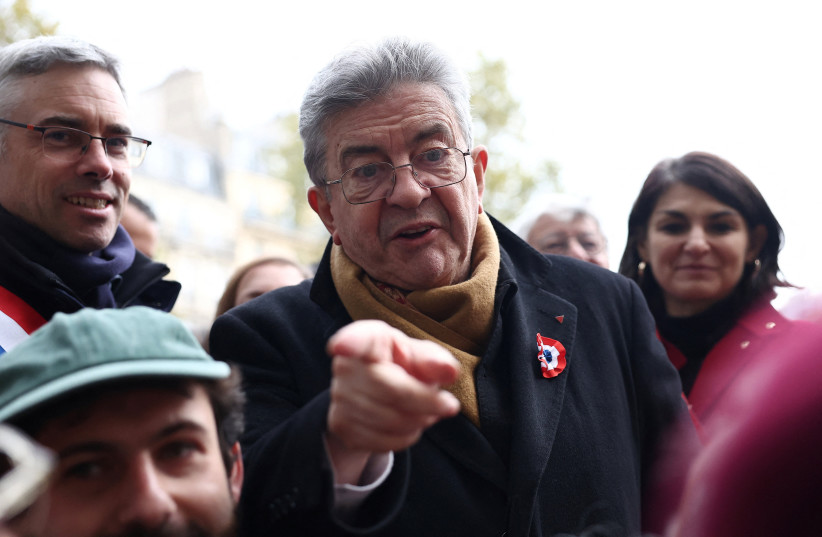
Growing alarm over far left contrasts with historical baggage of far right
Explaining the concerns surrounding the two candidates, Perez-Pariente pointed to the historical baggage of the far right alongside growing alarm over the far left.
"For a long time, the far right was seen as the main political threat to the Jewish community," she said, noting that Le Pen's National Rally party was founded by her late father, Jean-Marie Le Pen, who was repeatedly condemned for antisemitic and Holocaust-related remarks. While Marine Le Pen has sought to distance herself from that legacy and has vocally condemned Hamas and antisemitism since October 7, 2023, Perez-Pariente noted that "doesn't mean the party's history has been forgotten, or that antisemitic prejudices have disappeared among its supporters."
By contrast, Perez-Pariente said the level of concern surrounding Mélenchon and LFI has become "quite striking." Following the October 7, 2023 attacks, Mélenchon drew widespread criticism from Jewish groups over his refusal to immediately label Hamas a terrorist organization, his description of antisemitism in France as a "residual" phenomenon, and remarks involving Jewish public figures, though he rejects accusations of antisemitism.
"With Mélenchon, I think the fear is that the distinction between hostility toward Israel and hostility toward Jews will become even more blurred, and that certain forms of antisemitism will increasingly be tolerated when expressed in political language," Perez-Pariente told the Post. "With Marine Le Pen, the concerns are different and relate more to the history of the far right and the broader political environment her election could create."
The survey found that 86% of French Jews believe Mélenchon contributes to the rise of antisemitism in France, alongside 68% who said the same of Greens leader Marine Tondelier, 62% for Socialist Party leader Olivier Faure, and 56% for Communist Party leader Fabien Roussel. Perez-Pariente noted that 31% of French Jews said the same of Le Pen, saying the gap "say[s] a great deal about how perceptions have evolved."
Over three antisemitic incidents daily reported in 2025
The findings form part of the latest 'Radiography of Antisemitism in France' barometer, which examined public attitudes and the experiences of the Jewish community three years after the October 7, 2023 massacres. The report noted that 1,320 antisemitic acts were recorded by the French Ministry of the Interior in 2025, averaging more than three incidents per day.
"As for how the community feels, I would say there is a real sense of anxiety, but also exhaustion," Perez-Pariente said. "French Jews have lived with a very high level of antisemitism for years, and October 7 clearly marked another turning point. What worries me most in our findings is not only the number of people who have experienced antisemitism, but how much it is affecting their everyday lives."
According to the report, 82% of French Jews reported being victims of an antisemitic act during their lifetime, including 60% who experienced insults and 35% who faced threats of physical aggression. Meanwhile, two-thirds (66%) said France is not a safe country for Jews, and 69% have adopted avoidance behaviors since October 7, 2023, including 48% who have stopped wearing distinctive religious symbols in public and 29% who have removed mezuzahs from their doorframes, a 10-point increase from the previous survey.
Perez-Pariente also pointed to a troubling disconnect between public recognition of the problem and action. While 79% of the general public acknowledged that antisemitism has risen over the past decade, only 38% said they would be willing to protest against it, down from 46% in 2024. "There is a growing gap between awareness and mobilization," she told the Post. "And I think that is ultimately what worries many French Jews. It's not just whether the next president will protect them. It's whether French society as a whole is still willing to stand up for them."
Additional findings from the report underscored hostility linked to Israel and skepticism toward the justice system. Nearly four in five French Jews (79%) reported being accused or held responsible for the actions of the Israeli government, while 23% of the general French public said it is justified for Jewish citizens to be targeted over their real or perceived support for Israel. Furthermore, 40% of French respondents deemed it acceptable to boycott events featuring Jewish figures suspected of pro-Israel positions, while only 46% considered such a boycott antisemitic.
Among the general public, ideas associated with the far left and the far right were cited in equal proportions by 25% of respondents as primary drivers of antisemitism. Among LFI sympathizers, 51% agreed that Jews hold too much power in finance and the economy, 50% expressed similar views regarding the media, and 81% stated that Israel behaves toward Palestinians the way Nazis behaved toward Jews, a view also shared by 49% of French youth aged 18 to 24. Meanwhile, only 22% of Jewish victims file a police complaint, amid public sentiment from 75% of respondents that courts do not sentence perpetrators severely enough and 70% who said the justice system struggles to recognize antisemitic motives.