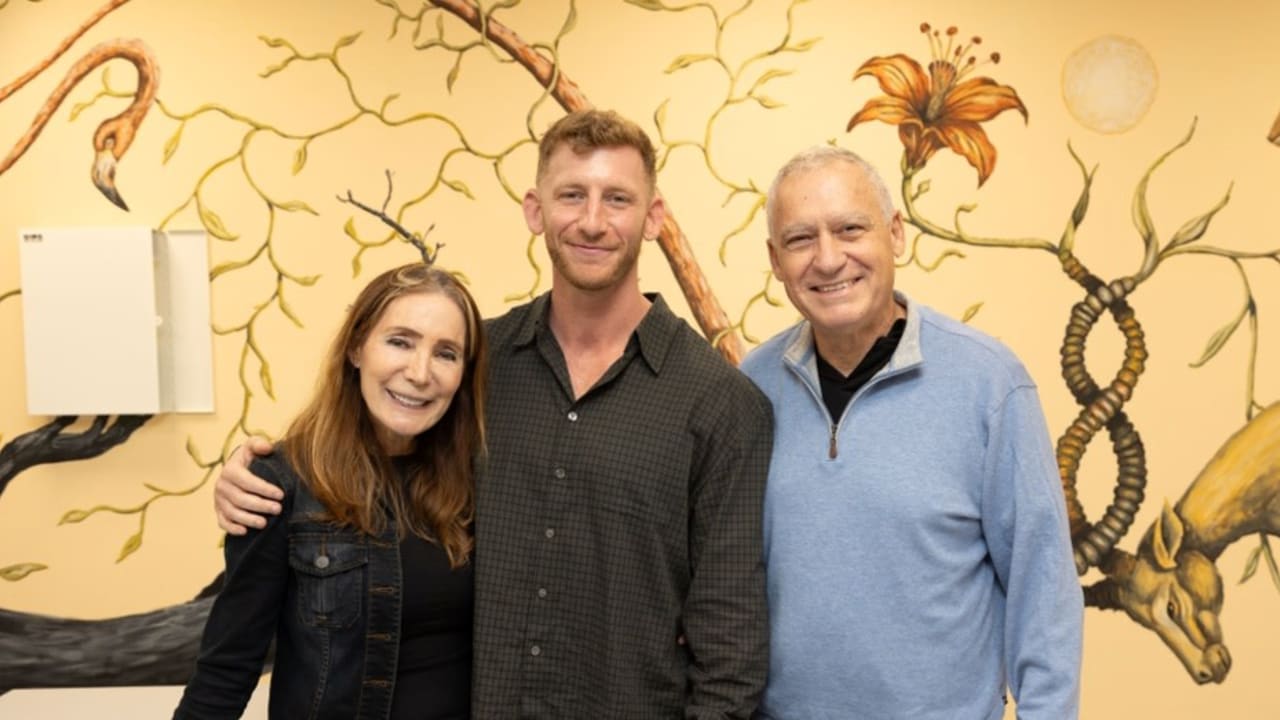
Dr. Shakked Halperin, a 35-year-old Israeli-American biotech entrepreneur, recently funded the renovation of a biology laboratory at Geon HaYarden Darca School in Israel’s northern Valley of Springs.
Over the past three decades, Israel has built its reputation as the Start-Up Nation, developing technologies that have transformed industries worldwide. Yet while the country continues to strengthen its position as a global innovation hub, access to the educational opportunities that help develop future scientists and entrepreneurs remains relatively uneven.
According to figures published by the Education Ministry, just 17% of students earned a five-unit mathematics matriculation qualification in 2026, while slightly over 11% qualified for the advanced Bagrut-Tech track. Although these numbers reflect progress, they also highlight the challenge of broadening participation in advanced scientific and technological education
This gap matters most outside cities that serve as Israel’s major tech and research hubs, where access to advanced facilities and hands-on learning experiences can be limited. Without these resources, students may have fewer opportunities to discover interests that could influence their future academic and professional paths.
For one entrepreneur who built his career around scientific discovery, closing that gap has become a personal mission.

Shakked Halperin Foundation inaugurates new school laboratory in first initiative
Inaugurated on November 8, the new laboratory funded by Halperin marks the Shakked Halperin Foundation's first initiative, established to expand access to science, education, and entrepreneurship across the country, with a particular focus on underserved communities across Israel’s periphery.
Before shifting his attention towards education, Halperin founded two biotechnology companies focused on developing advanced DNA-editing technologies, both of which were acquired in deals valued at up to $385 million combined. Intellia Therapeutics acquired his first venture, Rewrite Therapeutics, in 2022 in a deal valued at up to $200 million. Two years later, his second company, Replace Therapeutics, was acquired by Tome Biosciences in a deal valued at up to $185 million.
Despite his scientific achievements, Halperin did not initially envision a career in the field. Born to Israeli parents and raised in St. Louis, Missouri, Halperin struggled to find his place in the traditional education system and considered pursuing art before developing an interest in science. What began as an unexpected interest eventually took him to the University of Cambridge and later the University of California, Berkeley, where he completed his PhD in bioengineering in just three years.
His experience has since influenced his approach to philanthropy, particularly his focus on exposing students to scientific subjects at an earlier age. At Geon HaYarden Darca School, the renovated laboratory is designed to give students greater opportunities to conduct experiments, explore biological processes, and develop practical research skills.
Halperin combines art, science with laboratory mural
Halperin also painted a large mural in the laboratory himself, combining his passion for art and science to create a more inspiring learning environment for students. The project also carries personal significance for Halperin, who dedicated the laboratory to his parents in recognition of their influence on his education and career.
Dr. Shakked Halperin shared, "It took me time to discover my passion for science and realize that this was where I belonged. I know there are children with extraordinary talent and curiosity who may never have the chance to discover their abilities, simply because they were never exposed to the right opportunities. I want to change that.”
Israel's tech sector has benefited from investment in research and development, but building a talent pipeline happens long before students enter university or the workforce. Giving more schools access to modern laboratories and practical learning opportunities could help broaden participation in advanced science education. The results may not be felt immediately, but the students entering these classrooms now could shape Israel's scientific sector in the years to come.