In May 1951, three years after Israel's founding, David Ben-Gurion became the first Israeli prime minister to visit the United States. On May 6, he flew to Knoxville and spent two days touring the Tennessee Valley Authority dams.
He came for water and power, and to see whether the TVA model could work in a small, dry country. He called it "One of the greatest construction works of our time." That year, he decided to build the National Water Carrier, which would push water south toward the desert he believed held Israel's future: the Negev.
At a dinner in his honor, Governor Gordon Browning introduced him to members of the Atomic Energy Commission. Twenty-five miles away was Oak Ridge, the "Secret City" where the uranium for the Hiroshima bomb had been enriched six years earlier.
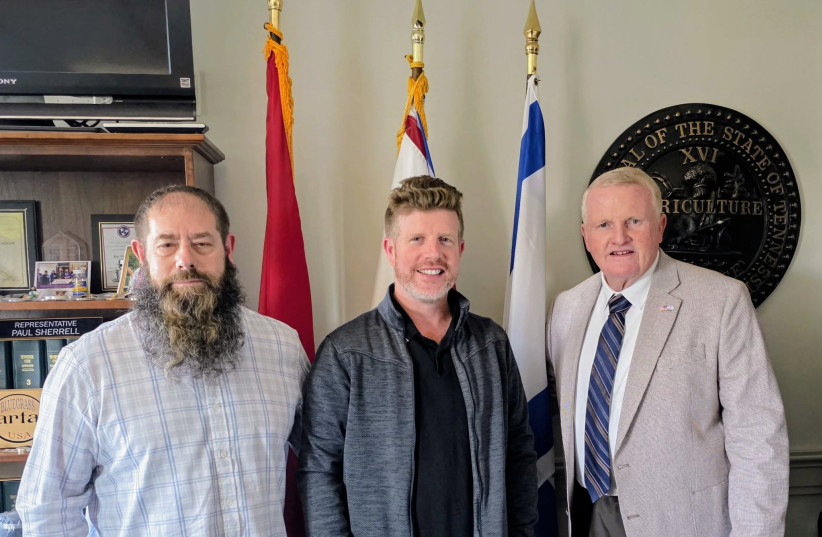
This fall, I followed his route to Hamitbah, the Western Negev Innovation Authority, which works with some 200 start-ups and companies in the region bordering Gaza. The Consulate General of Israel to the Southeast in Atlanta backed the mission, and Andy Neukman, founder of the Tennessee-Israel Legislative Caucus, hosted it.
Neuman told me the caucus grew after protesters gathered outside a Nashville synagogue. Today, about 110 of the 132 General Assembly members belong to it. "Tennessee is open for business," said its chairman, Rep. Scott Cepicky.
The defense gap
Jennifer Kay of Deep Tech Go to Market, who helps companies sell to the US government, told me the market for simple drones is crowded.
"I hypothesize that the next ridge line for the Department of War relative to unmanned systems is going to be subsurface capability," she said. That means underwater and underground: communications without radio signals, and navigation where GPS is jammed.
The Western Negev learned these problems the hard way. Its companies build passive 4D radar, underground seismic sensors and counter-drone systems proven in real conditions. Tennessee has the ranges to show them to American buyers, from Arnold Air Force Base near Tullahoma to a Navy test channel in Memphis that Brian Evans of the University of Memphis described as a place to test hulls, torpedoes, and drones.
The catch is federal rules: no Chinese components, and often a US entity with 51% American ownership. Kay offered to help match Negev firms with partners for BIRD Foundation grants of up to $1.5 million.
The atomic city and its Japanese friends
In Oak Ridge, former state representative John Ragan walked me through the town's history. At the East Tennessee Economic Council, president Tracy Boatner and Bill Tindal of the Tennessee Nuclear Network described more than $10 billion in civilian nuclear investment, from Oak Ridge National Laboratory to TVA's planned small modular reactor on the Clinch River.
On the Gaza border, where power cuts come with rocket fire, micro-reactors that keep a hospital running off the grid need no explaining.
What surprised me most was Japan. The city that enriched the uranium for Hiroshima has been a sister city of Naka, Japan, since 1990.
An International Friendship Bell hangs downtown. Japan is now Tennessee's largest foreign investor, with Nissan and Bridgestone among its biggest employers, and Japan's Kyoto Fusioneering works on fusion in Oak Ridge. Former enemies chose to build together. That is a lesson worth carrying home to a region still at war.
Farms, minds, and factories
At the University of Tennessee Institute of Agriculture, Dr. Keith Carver and Hannah, who leads campus tours, explained that the state loses about 12 acres of farmland an hour, and the average farmer is 65. The institute tests new tools on 31,000 acres so farmers don't carry the risk alone.
Rep. Chris Todd, who chairs the House agriculture committee, put it simply: "Israel has some of the best technology in the world. What they don't have is a lot of land and water to test it." I gave Carver an amaryllis bulb from a Gaza-border kibbutz, sealed in wax. It blooms without a drop of water.
In Memphis, Dr. Leah Windsor of the Institute for Intelligent Systems is building a mental health app for farmers under chronic stress. Dr. Linh Luu, who heads student counseling, said students seeking help there average six on the Adverse Childhood Experiences scale, compared with 1.5 nationally.
At Columbia State Community College, Dean Kae Fleming explained to us on a 3D trailer that trains first responders on disaster scenes. Our communities have spent two decades building tools for trauma.
In Clinton, Andy Wallace of the Anderson County Economic Development Association and Gary Human of the state's economic development department showed how IWI US, led by Casey Flack, runs an Israeli-owned factory staffed by Tennesseans. "We are a AAA credit-rated state with a balanced budget and no state income tax," Human said.
What comes next?
Hamitbah aims to become Tennessee's partner on the ground in the Western Negev, vetting companies and bringing deals to the state's economic development department and its global investment director, Karel Abboud.
The next steps are already on the table: county-to-county agreements linking Western Negev councils with Madison, Anderson, and Maury counties, joint bids for BIRD and BARD grants, and a Tennessee delegation to the Negev in March 2027 to sign them.
Ben-Gurion came to Tennessee to learn how to make a desert bloom. He went home and built the pipes that carried water south. Seventy-five years later, the desert he believed in has bloomed in a way he could not have imagined: with sensors, software, and the hard lessons of living on a border. Now the Negev has something to offer back.
The writer is the director of innovation diplomacy and strategic partnerships at Hamitbah, the Western Negev Innovation Authority.