Medical and scientific researchers often keep discoveries quiet until peer-reviewed publication to protect their intellectual property. When they do desire cooperation, Zoom, WhatsApp, and email can bring them together without them meeting in person.
But an impressive new partnership in Jerusalem proves that when multidisciplinary exchanges are made in a single place, “rubbing elbows” in meeting rooms and even over a cup of coffee, multidisciplinary teams create a synergy that produces groundbreaking results.
This will be implemented by Israel’s first-ever joint academic body to promote research, innovation, and entrepreneurship in the capital’s “Innovation District Healthcare and High-Tech Revolution,” which has been officially and cleverly named FourWard.
The Hebrew University of Jerusalem, Shaare Zedek Medical Center (SZMC), Azrieli Jerusalem Academic College of Engineering and the Orthodox-friendly Lev Academic Center (Jerusalem College of Technology), together with the Jerusalem Municipality and the Jerusalem Development Authority, are launching an unprecedented platform for collaboration among academia, the healthcare system, industry and entrepreneurship, while promoting applied research, technology commercialization, the establishment of start-ups, the development of advanced human capital and the connection between researchers, entrepreneurs, investors and knowledge-intensive industries.
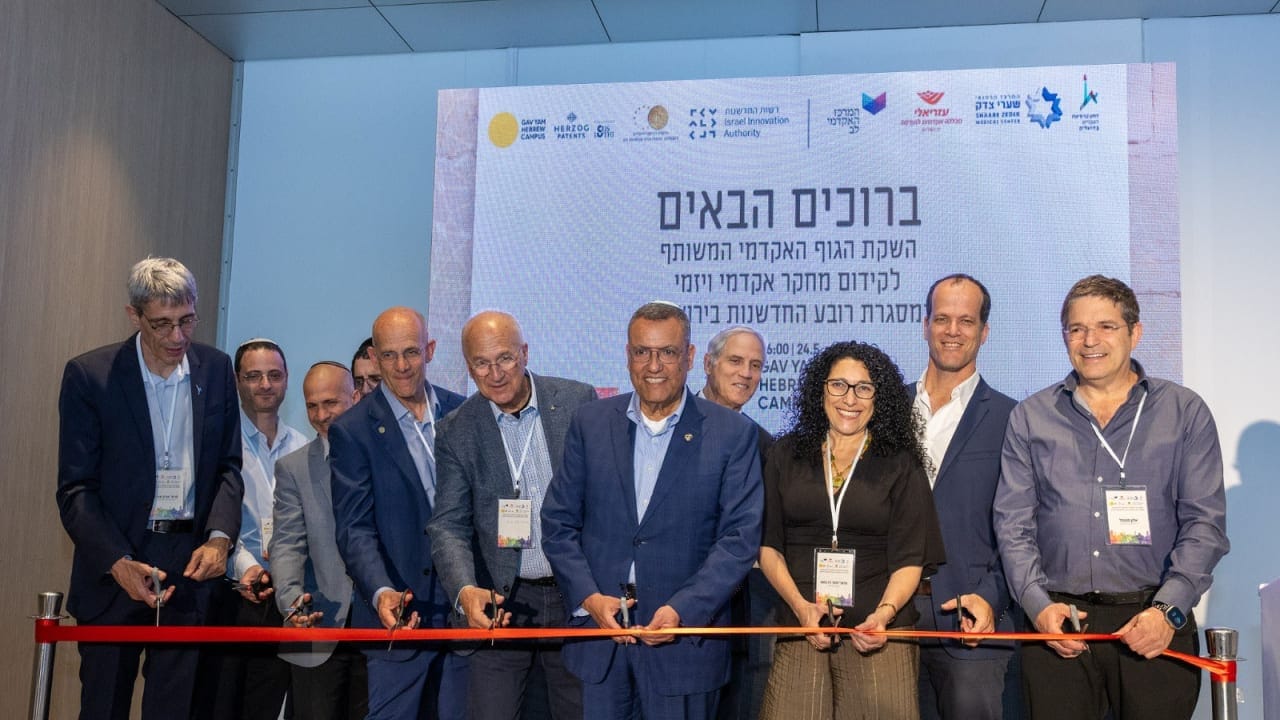
It officially launched last week at HUJI’s Givat Ram campus, but the building where researchers will meet will eventually be erected near Road 16 and the Begin Highway – a central hub connecting all four partners.

The event was attended by Jerusalem Mayor Moshe Lion, SZMC CEO Prof. Ofer Merin, Lev Academic Center CEO Roi Ohev Zion, Jerusalem Development Authority CEO Tzachi Namir, and 100 representatives of academia, the healthcare system, the government, and the country’s innovation industry.
Unprecedented platform for collaboration
A public company owned by the partnering institutions is being established to create this unprecedented platform for collaboration, while promoting applied research, technology commercialization, and the establishment of start-ups. Azrieli and Lev are each covering a sixth of the initial expenses, while the other two partners are each allocating a third. They expect that the effort will create advanced human capital development and a connection among researchers, entrepreneurs, investors, and knowledge-intensive industries.
The effort will significantly strengthen Jerusalem’s position as one of the country’s main growth engines in Israel in the coming decades, a capital of innovation and science and an international hub that connects groundbreaking research, as well as the founding of start-ups and companies. It will open new high-level jobs for qualified personnel and attract them to live in Jerusalem.
In an interview with In Jerusalem, Lev Academic Center president Prof. Avi Domb – who was previously president of Azrieli College, head of HUJI’s School of Pharmacy, and the Science Ministry’s chief scientist – conceded that the timing is challenging and problematic. Research budgets around the world are under pressure; competition for grants is fierce; and international collaborations can be affected by political considerations.
“As Israel is unfortunately not very popular around the world today, FourWard will have to prove itself in an increasingly competitive and uncertain global funding environment – not to lower expectations but to raise them by producing world-class research, nurture breakthrough technologies, and create an innovation ecosystem compelling enough that partners and investors will want to be part of it,” he stated.
“We believe we can still get grants to create new technologies. We aim not to write journal papers but to create new technologies. We won’t replace the research facilities of each partner. FourWard will be a place to meet, discuss in shared spaces, hold seminars, plan, and coordinate.”
Asked for examples of what new medical technologies could be produced, Prof. Dan Turner – director of SZMC’s Pediatric Gastroenterology Institute and the hospital’s vice president of R&D and innovation – said: “We cooperate with HUJI and the Lev Academic Center all the time, but, for example, now we can use our joint databases to look at the thousands of drugs taken for many years by patients and find out whether they were protective or caused harm. All data will be private and anonymous. Instead of pushing a catheter into the blocked coronary arteries of patients, a tiny robot can be introduced into the body to fix.”
This isn’t a pipedream, he said; it recalls the movie The Fantastic Voyage from 1966, in which a blood clot makes a scientist comatose, and a submarine and its crew are shrunk and injected into his bloodstream to save him.
“Cooperation with Azrieli is also improving hip replacements and treating devastating bone infections that can result from them. Another example, collaboration with Azrieli now to do change bones. We are developing together a chip left in the body to identify early infections so antibiotics can be given faster. Biological drugs can replace some types of antibiotics to which there is bacterial resistance. We at SZMC are the first in the world to have a system in which a doctor asks for a blood test for a patient, and AI can predict the results of the tests with 99.5% accuracy and suggest adding or removing tests.
“There are dozens of ideas; the sky is the limit. Working together, one plus one will equal three. Collaboration by different organizations is better than one seeking a solution,” Turner added.
If SZMC has a problem it can’t solve alone, Azrieli can offer engineering ideas, and HUJI can suggest pure science to create a solution, said Amit Persiko, the vice president and CEO of Azrieli. “The initiative started with the Jerusalem Municipality, and then a government decision followed 18 months ago,” he said. “Jerusalem is one of the most diverse cities in the world, with secular, Modern Orthodox, and haredim and Arabs – and they are all represented at Azrieli in its student body and staff. A third of our students are IDF reservists, 42% of our engineering staff are women.”
Persiko noted that a major new field is bioconvergence – a multidisciplinary field that merges biology, engineering, and computation to create cutting-edge solutions for complex challenges. It enables breakthroughs like personalized medicine, regenerative therapies, and bio-inspired materials across healthcare, agriculture, and climate sustainability, tissue engineering, smart biosensors, organs-on-chips, bioprinting, creating vascularized 3D tissues from living cells for regenerative medicine, and even integrating electronic components to monitor or stimulate tissue.
Dr. Renana Ofan, director of SZMC’s Research and Development Authority, who is a leading neuroscientist, said that “the partnership is not targeted on one subject or just health but on many disciplines. FourWard would like to get a grant quickly to present the fruits of our efforts. Doctors will initiate projects because they meet with patients daily, see their distress, and know what is needed.”
President Isaac Herzog sent his congratulations at the opening ceremony, affirming the promise: Jerusalem Innovation District will catapult the capital a big step forward.