
Parashat Vayetze introduces us to the matriarch Rachel, whose spiritual path was very different from that of the matriarchs before her.
Like Sarah, Rebecca, and Leah, she did not inherit her faith; she had to discover it for herself. But unlike them, Rachel’s relationship with God developed mainly through doubt, uncertainty, obstacles, and setbacks.
For those of us who struggle with faith, it makes her story very much our own.
Rav Amnon Bazak suggests that much can be learned about Rachel’s spiritual development by comparing her with the earlier matriarchs. When Rebecca first learned of the possibility of marrying Isaac, she ran to tell her mother (Genesis 24:28), apparently the spiritual figure in her family.
By contrast, upon first meeting Jacob, Rachel “ran to tell her father” (29:12), Laban, hardly the most pious figure in the text. This early association offers a clue to the influences that shaped her.
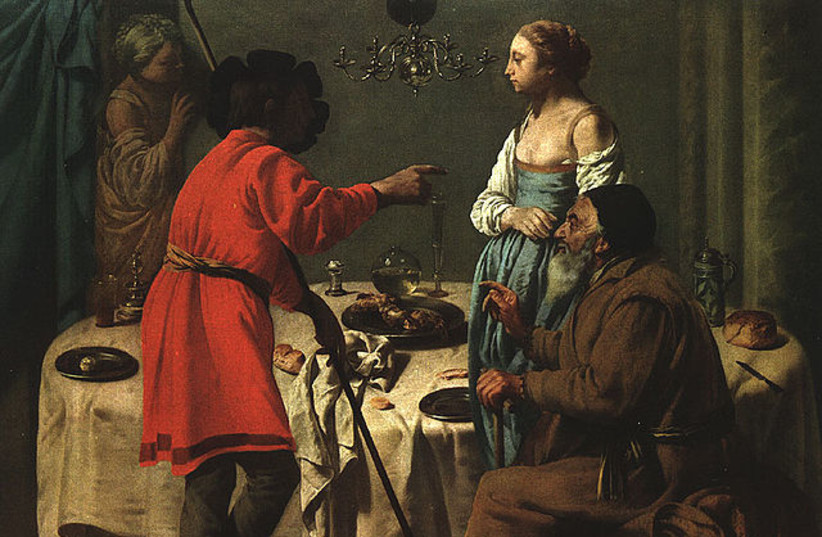
When Rachel cannot have children, the Torah tells us that she “became envious of her sister” (30:1), a word never used to describe Sarah, even with Hagar. In her pain, Rachel confronts Jacob; she speaks fiercely: “Give me children! If not, let me die!” (ibid.).
Unlike Sarah, there is no “please.” Her words are not a request or a prayer, but a demand. Hence Jacob’s reprimand: “Am I in place of God, who has kept you from having children?” (v. 2).
His response reminds her that God is the only one with the power to grant children.
When Sarah faced hardship, she turned to God; when Rebecca’s pregnancy troubled her, “she went to inquire of the Lord” (25:22). Rachel’s prayers, however, do not mention God at all.
In the only conversation the Torah recounts between Rachel and Leah, over the mandrakes [duda’im], Rachel is willing to give up a night with Jacob in exchange for a plant-substance traditionally associated with fertility (v. 15).
Once again, she seeks a transactional solution rather than turning to God.
Still, we eventually read: “Then God remembered Rachel and listened to her and enabled her to conceive” (v. 22).
Perhaps Rachel had been praying all along, even if the Torah does not describe it; perhaps not with the proactive efforts of the earlier matriarchs, or Leah, who invokes God repeatedly in naming her children.
When Joseph is born, Rachel acknowledges God’s role, but with an eye to the future: “May the Lord grant me another son also” (v. 24). But with Rachel, it is not about acknowledging the current gift of a child but about the future.
Her words suggest a developing faith, one shaped by years of experience and introspection. Like many of us, Rachel does not come to spirituality easily; she is her father’s daughter.
Then comes the remarkable episode of the theft of Laban’s terafim, household idols (31:19). Rashi’s well-known explanation is that Rachel took them to prevent her father from worshiping them.
Ibn Ezra challenges this position (ibid.), asking: If so, why not simply throw them away?
Shadal (ibid.) offers a more troubling possibility: Rachel wanted to use them for herself – not for worship, for by now she was loyal to God, but for divination, to learn whether and when God would grant her more children.
As she dies giving birth to her youngest son, Rachel names him Ben Oni (35:18), traditionally understood as “the son of my sorrow.” But the Hebrew word oni can also denote iniquity, wickedness, trouble, or wrongdoing.
Strikingly, 1,000 years later, the prophet Zechariah links the word “terafim” to falsehood (on), a word that also echoes the name Ben Oni: “For the terafim spoke falsely” (Zechariah 10:2).
Perhaps, beyond its familiar meaning as an expression of sorrow, the name Ben Oni also reflects Rachel’s recognition of the failures, mistakes, and falsehoods in her life and in her relationship with God. In her final moments, she completes a process of teshuva, repentance.
And perhaps that is why, in Jeremiah’s prophetic vision, Rachel is heard “weeping for her children” (Jeremiah 31:14). She can plead for the Jewish people when they are suffering because she understands their struggles.
She knows what it means to search for answers in the wrong places and to find a path back to God. She can say: They can do teshuva; they can grow. I am that person.
Rachel is the matriarch whose own experience gives her the compassion to advocate for her children.
Faith does not always come easily
Her journey is also the message of our haftarah.
Hosea exposes the people’s deceit and guile, their idolatry and superstition: “Now their sinning goes on and on; they cast graven images from their silver, mold idols as they understood, each entirely the craft of men” (Hosea 13:2).
Yet the prophet also insists powerfully that return is possible: “O Israel, return, go back to the Lord your God, for you have stumbled in your own sinfulness. Take words of remorse with you and return to the Lord” (14:2–3).
God promises to forgive their rebellion: “I will mend their rebellion with gracious love, for I have turned my anger away from them” (v. 5). True security lies not in household idols or other sources, but in God: “your help is to be found in me” (13:9).
Rachel’s story reminds us that faith does not always come easily or develop in a straight line. This message is especially relevant today, when so many of us are grappling with loss, uncertainty, and questions without easy answers.
We may seek reassurance in places that cannot provide it, or mistake doubt for spiritual failure. But Rachel teaches us that the struggle itself can be part of our growth.
That is the promise of Hosea’s call to return, and of Rachel’s tears for her children. However far we may have wandered, the possibility of finding our way back always remains open.
The writer is the president and rosh yeshiva of Ohr Torah Stone.