
There was one word that echoed across Tehran during the funeral of Ayatollah Ali Khamenei.
It was not peace. It was not unity. It was not reconciliation.
It was revenge.
As hundreds of thousands filled the streets, the chants rolled like thunder: “Revenge! Revenge! Death to America! Death to Israel!” Waving above the crowd were blood-red flags, symbols deeply rooted in Shi’ite tradition.
These are not merely political banners. They are declarations that blood has been spilled, and that vengeance is now a sacred obligation. In the theology of Iran’s revolutionary leaders, revenge is not simply an emotional response; it is a religious duty.
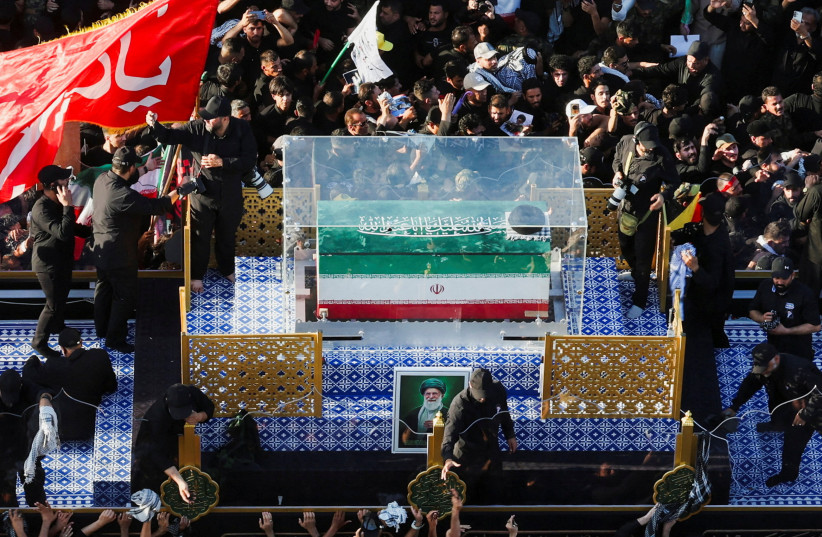
The Western press will inevitably focus on the size of the crowds or the spectacle of the funeral procession. They will describe the mourners’ emotion and perhaps mention the slogans in passing. What many will fail to understand is that this funeral was not simply the burial of a supreme leader. It was a reaffirmation of the ideology that has driven the Islamic Revolution since 1979.
The message coming from Tehran was unmistakable: the war against America and Israel did not end with Khamenei’s death. If anything, the cries for revenge declared that the mission would continue.
I have seen Iran’s terror firsthand
I do not write about Iran from an academic perspective or from behind a television camera. I have witnessed the consequences of this regime’s ideology with my own eyes.
I was in Beirut following the bombing of the US Marine barracks in 1983, where 241 American servicemen, 220 Marines, 18 sailors, and three soldiers were murdered in one of the deadliest terrorist attacks in American history.
The devastation was overwhelming. Buildings had been reduced to rubble. Families mourned sons who would never return home. Young men who had volunteered to serve their country were buried beneath concrete because the Iranian regime had chosen terrorism as an instrument of foreign policy.
That attack was part of Iran’s strategy of exporting its Islamic Revolution through terrorist proxies, including Hezbollah. Iran had already demonstrated its willingness to murder Americans to advance its revolutionary agenda, and the world was put on notice that terrorism had become one of its principal instruments of power.
The dangerous lesson Iran learned
The world expected America to respond with overwhelming force. America had an opportunity to convince the ayatollahs that murdering Americans would carry an unbearable cost. Instead, a very different path emerged.
Rather than delivering the kind of decisive retaliation that would have permanently altered Iran’s calculations, the United States became entangled in what later became known as the Iran-Contra affair. Despite an arms embargo, American missiles were secretly shipped to Iran, while proceeds from those sales were used to fund the Contras fighting in Nicaragua. Whatever the intentions behind the operation, the message received in Tehran was unmistakable.
The ayatollahs reached a dangerous conclusion: America could be manipulated. They believed Washington lacked the resolve to finish what it started. They watched a nation that publicly condemned them secretly negotiate with them. They concluded that terrorism created leverage, hostage-taking produced concessions, and eventually America would compromise.
The Iran-Contra scandal did more than create political controversy in Washington. It convinced the Iranian leadership that the United States lacked the consistency necessary to defeat them. That perception became one of the greatest strategic victories the Islamic Republic ever achieved because it emboldened the regime to continue using terrorism as an instrument of state policy.
Revenge is not a political slogan
Many Americans continue to analyze Iran as though it were simply another nation pursuing ordinary geopolitical interests. That is a profound misunderstanding.
The leaders of the Islamic Republic see themselves as participants in a divine mission. Their worldview is shaped by revolutionary Shi’ite theology, where martyrdom, sacrifice, and vengeance are celebrated as acts of religious devotion.
When red flags are raised over mosques or carried through funeral processions, they symbolize a continuing obligation to avenge blood that has been shed. Those flags flying throughout Khamenei’s funeral were sending a message not only to the Iranian people but to the entire world.
The repeated chants of “Death to America” and “Death to Israel” were not emotional outbursts from an angry crowd. They were declarations from a movement that has spent nearly half a century defining itself through opposition to the United States and the destruction of Israel. These slogans have been taught in schools, preached in mosques, broadcast on state television, and repeated by successive generations of revolutionary leaders.
To dismiss them as political theater is to ignore nearly five decades of history.
Delusion comes at a high price
Anyone who believes Iran has abandoned its desire for revenge simply because leaders have changed, negotiations have occurred, or military setbacks have been suffered is refusing to confront reality. The ideology of the Islamic Revolution did not die with Khamenei, nor will it disappear with the next supreme leader.
The objective remains exactly what it has always been: to destroy Israel, drive American influence from the Middle East, and export the Islamic Revolution across the region. Their tactics may evolve. Their timelines may change. Their methods may adapt. But their long-term goals have remained remarkably consistent for more than 45 years.
Too often, free societies convince themselves that dictators do not truly mean what they say. They explain away threats as propaganda or assume economic interests will eventually overcome ideological fanaticism. Iran has spent decades proving otherwise.
The cries of “Revenge!” heard throughout Tehran were not symbolic. They were a reminder that the regime continues to define itself through conflict with America and Israel. Anyone who believes that Iran will simply forget decades of humiliation, accept military defeat, and ideological commitment is living in a dangerous fantasy.
The funeral of Ali Khamenei was not the end of an era. It was a pledge that the Islamic Revolution would continue. The chants of “Death to America” and “Death to Israel” were not relics of the past. They were promises for the future.
America ignored Iran’s intentions once before, and 241 Marines paid the price. We cannot afford to make that mistake again.
When an enemy publicly chants “Revenge,” waves the red flag of vengeance, and openly vows your destruction, wisdom demands that you believe exactly what they are saying.
The writer has written 120 books and is a #1 New York Times bestselling author and Nobel Peace Prize nominee. He is the founder of the Friends of Zion Museum in Jerusalem, the Ten Boom Museum in Holland, and Churches United with Israel, one of the largest Christian Zionist networks in America.