
The slogan “Queers for Palestine” evokes solidarity with the oppressed.
Yet it often exposes a central contradiction in contemporary progressive politics: queer identity is used to legitimize a cause whose dominant political and armed forces would not protect queer life but erase it.
The problem is not that queer people care about Palestinian aspirations for statehood. Nor is it that activists criticize Israeli governments.
Israel is a democracy with deep political divisions, and many Israelis oppose their own government’s policies. The problem begins when concern for Palestinians is accompanied by silence – or outright ignorance – about the realities faced by queer Palestinians themselves.
Many pro-Palestinian activists denounce Zionism – the Jewish people’s right to self-determination – as one of the defining evils of our age, while saying remarkably little about Hamas, the Palestinian Authority, religious coercion, patriarchal violence, or the persecution of LGBTQ people in Palestinian society.
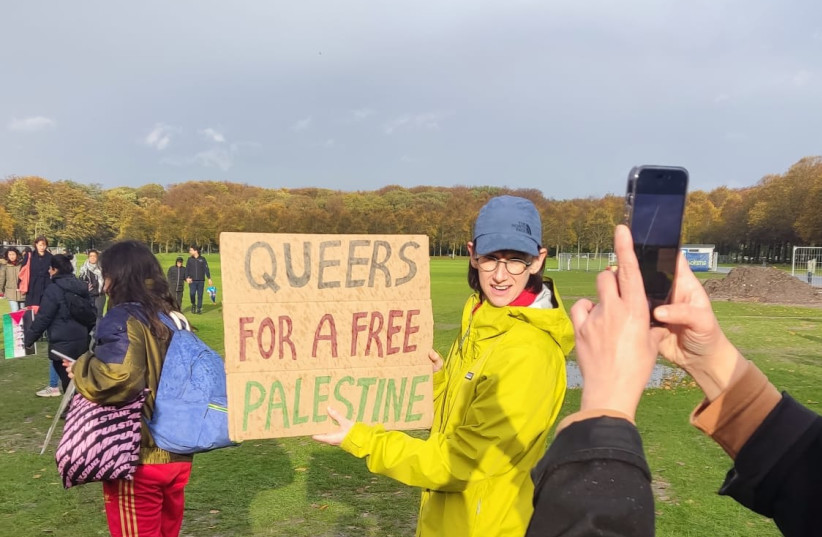
The absurdity of this position was captured in a widely shared interview during a pro-Palestinian demonstration in Boulder, Colorado. A visibly queer activist was asked what would happen if he walked through Gaza dressed as he was.
He replied that his “white privilege” and American citizenship would protect him. It was a fantasy. In Gaza, neither privilege nor passport guarantees safety. Queer Palestinians know this better than anyone.
The contradiction is even sharper among queer activists with roots in the Middle East who enjoy freedoms in Berlin, Amsterdam, or New York that are denied across much of the region: the freedom to live openly, organize, publish, and protest.
Yet some use those freedoms not to defend universal queer rights but to demonize the one country in the Middle East where queer public life exists openly on a large scale.
This double standard is often expressed through accusations of “pinkwashing” – the claim that Israel promotes LGBTQ rights to distract from its treatment of Palestinians.
But this is largely a straw man. Serious defenders of Israel do not argue that gay rights justify Israeli security policies.
Debates about the conflict are based on security, law, and competing national claims – not on Tel Aviv’s LGBTQ-friendly clubs or the absence of comparable public queer life in Ramallah.
No one claims that same-sex parenthood cancels out security-based checkpoints. The criticism of alleged “pinkwashing” pretends to expose propaganda but often functions as propaganda itself.
What it cannot erase is the reality of flourishing queer life in Israel.
That reality complicates the anti-Israel narrative because it highlights an uncomfortable fact: the freedoms that make queer life possible in Tel Aviv are precisely the freedoms denied by many of the movements romanticized by activists.
This year’s Tel Aviv Pride Parade made that contrast impossible to miss.
On June 12, more than 100,000 people filled the streets for the city’s first Pride Parade since the October 7 massacre.
Even as missiles from Iran and Yemen had sent Israelis into bomb shelters only days earlier, Tel Aviv still turned its streets into a public celebration of freedom, openness, and belonging.
In Gaza, by contrast, a pride parade would likely be crushed before it began.
Even anti-Hamas protests planned for June 26 were met with intimidation and violence by the very “resistance” movement celebrated by many “Queers for Palestine” activists.
The freedoms visible at Tel Aviv Pride did not emerge by accident.
Over the past four decades, Israeli LGBTQ activists have fought for them in the streets, through public campaigns, in the Knesset, and above all before the Supreme Court.
They challenged religious parties, conservative politicians, and deep social prejudice. These rights were not gifts handed down by the state, but hard-won victories achieved through democratic struggle. And those battles are not over.
Queer rights in Israel: a hard-won reality
This is why the accusation of “pinkwashing” is so offensive. It reduces those hard-won achievements to public relations.
It tells Israeli LGBTQ people that their rights matter only when they can be used against Israel; otherwise, they are dismissed as an inconvenient narrative.
Israel, like every democracy, is imperfect. Same-sex marriages still cannot be performed domestically because marriage law is controlled by religious authorities. Homophobia exists among ultra-Orthodox Jews, Islamists, Arabs, Christian conservatives, and parts of the political right.
Jerusalem Pride still requires heavy police protection. But these shortcomings underscore the point rather than undermine it: Pride in Israel is evidence of democratic contestation.
Slogans such as “No Pride in Apartheid” or “No Pride in Genocide” pretend to offer moral clarity, but they rest on false and inflammatory accusations. Israel is not an apartheid state, and the war against Hamas is not a genocide.
These slogans do not explain the Israeli-Palestinian conflict; they reduce it to a stage play in which Israelis are always oppressors and Palestinians are always victims. Worse, they do nothing for queer Palestinians.
Serious queer politics would defend queer Palestinians and speak honestly about their horrendous situation in Gaza and the West Bank.
It would defend queer Israelis against antisemitic attacks. It would criticize Israeli governments without demonizing Israeli society.
Queer liberation cannot be built on selective blindness or political ignorance. It cannot excuse Hamas while erasing the democratic struggle of Israeli LGBTQ people. A movement that does so is not liberating. It is absurd.
Jan Kapusnak is a political scientist and freelance writer based in Tel Aviv. Felix Haibach is a historian and political scientist based in Munich and a former foreign-policy speechwriter for German Chancellor Helmut Kohl.