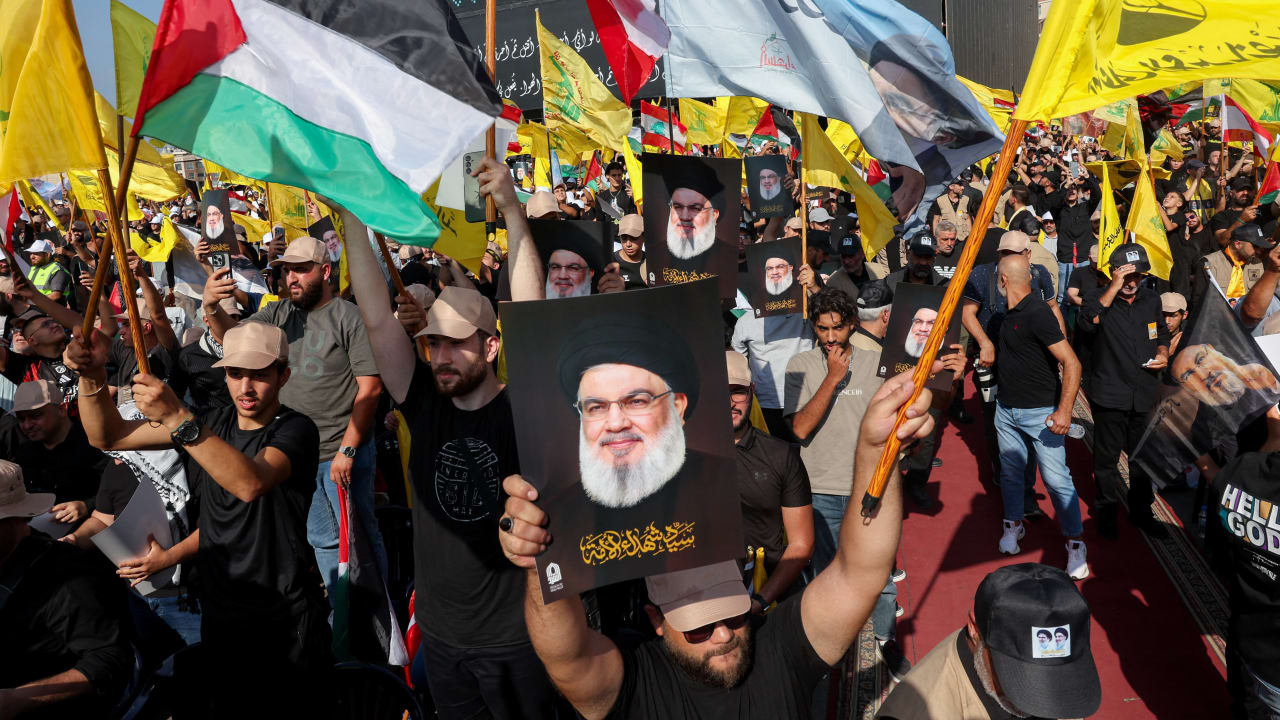
Two years after Israel assassinated Hezbollah leader Hassan Nasrallah in Beirut, the organization he shaped for decades is still struggling to rebuild its command structure, military capabilities, and strategic standing following a campaign that systematically dismantled the network around him.
On September 27, 2024, Nasrallah made one final choice. According to people intimately familiar with his routine and the security arrangements around him, he had safer places he could have gone that day. Nevertheless, he descended into an underground compound in Beirut's Dahiyeh neighborhood, beneath a multi-story residential building.
Soon after, the aircraft arrived.
"In the Nasrallah assassination, we dropped 83 bombs," said Col. (res.) S., who managed the IDF's target bank in the Air Force's Nahalat Binyamin unit. According to him, a similar level of firepower was later used against Hashem Safieddine, who had been marked as Nasrallah's successor.
The seconds during which the bombs were dropped ended the life of the man who had shaped Hezbollah and its place within the Iranian axis for decades. In a sense, however, the process of disintegration had begun earlier. Two years later, the organization is still trying to fill the vacuum he left behind.

But to understand why Hezbollah is still struggling to regain its footing two years after Nasrallah's assassination, it is necessary to return not only to the bunker where his life ended, but also to the months during which Israel dismantled, almost layer by layer, the system on which he relied.
In an extensive investigation published by Asharq Al-Awsat, Lebanese sources and Shi'ite clerics described how Israeli assassinations began isolating Nasrallah long before Israel reached him personally.
Israel cripples Hezbollah, assassinates field commanders
One cleric put it in almost brutally simple terms: Every time Israel assassinated a field commander, Nasrallah "lost an eye that helped him see clearly."
Sami Taleb Abdullah, Ibrahim Aqil, Wissam al-Tawil, and other commanders were more than names on an organizational chart. Each held an entire world of knowledge: weapons depots, connections on the ground, methods of operation, movement routes, operational plans, and personal relationships built over years.
The compartmentalization that had been one of Hezbollah's primary defensive mechanisms became a weakness during the war. According to the Lebanese sources, when a commander was assassinated, his replacement did not necessarily receive all the information the commander had possessed. Sometimes, the network he had built disappeared along with him.
At one point, one cleric said, Israeli drones circling above Hezbollah units knew more about those units than the newly appointed commanders responsible for leading them.
The cumulative losses also penetrated Hezbollah's operations rooms. Lebanese sources described chaos, improvised decision-making, and a sense that the organization was operating out of panic and suspicion rather than through an orderly chain of command.
Nasrallah nevertheless continued to believe in the old rules of the game.
Lebanese journalist Ali al-Amin said the Hezbollah leader remained convinced that the organization possessed enough deterrent power to prevent Israel from launching a broad war. Even when field commanders urged him to move to all-out war after watching Israel hunt their colleagues one by one, Nasrallah refused.
He chose defense. But that defensive perimeter was steadily closing in around him.
According to the accounts, Nasrallah first began to suspect that Israeli penetration was far deeper than he had believed in January 2024, following the assassination of Saleh al-Arouri and, later, Tawil. He had not expected either assassination. Afterward, Lebanese sources said, Nasrallah fell silent.
Hezbollah began examining its communications networks and searching for the breach. As the assassinations continued, suspicion grew, and the organization increasingly turned inward.
Nasrallah became 'different person' after pager attack
Then came the pager attack.
Wafiq Safa, one of Nasrallah's close associates, said in June that when he spoke with Nasrallah that day, he heard a different man in his voice.
"It was no longer the same Hassan Nasrallah," he said. "With everything Hezbollah went through over 40 years, put all of that on one side, and the pagers on the other. This was an entirely different event."
According to Safa, one of the mistakes made by those around Nasrallah was showing him the images. He saw the wounds, heard the number of casualties, and struggled to bear what he was seeing.
"He became a different person," Safa said.
According to Safa, Nasrallah almost stopped eating completely. For roughly 24 hours, he mainly drank water.
"For him, it was the end of the world," Safa said. "We have to be realistic: It was an intelligence penetration, and Israel deserves credit for it. We admit that."
Safa also heard the change during their personal conversation. Nasrallah hadn't called to get an update. He already knew what was happening. Instead, he had called to reassure Safa.
"I told him: 'The important thing is that you hold on.' Nasrallah replied: 'God comforts me.'"
"From that moment," Safa said, "Nasrallah was no longer the same Nasrallah."
Since the Second Lebanon War, an almost mythical image of Nasrallah had taken hold in Israel: He lived underground, hiding in a bunker, afraid to expose himself and run the organization from subterranean spaces.
Col. (res.) S. said the reality was far more complicated.
"We followed Nasrallah for a very long time," he said. "We knew his apartments, his wife's home, his emergency locations, and the places where he hid."
According to the officer, there were periods when Nasrallah did not live underground at all. At times, he stayed in a penthouse on the eighth floor of a residential building in Dahiyeh, where a special elevator let him quickly reach a protected space.
"He may have lived in a bunker conceptually," S. said, "but in practice, he wasn't underground all the time."
For those planning his assassination, the officer said, that did not make much difference.
"In every bunker he entered, we would have killed him. We had relevant attack plans for every building and every bunker."
On the day he was killed, the officer said, Nasrallah had more heavily protected options available to him. Nevertheless, he chose to go to the compound where his story ended.
The strike itself lasted seconds. The planning surrounding it took far longer.
S. said that before the operation, he sought to determine how long it would take a professional rescue team to reach people trapped at a destruction site of that scale. He asked the commander of the Home Front Command's rescue unit and received an answer: about six hours.
That answer, he said, led to another decision.
"I understood that in Lebanon they were less organized and that I needed to prevent anyone from approaching the site and trying to rescue survivors for 12 hours," he said. "We wanted to make sure Nasrallah would die, if not from the direct hit, then from blood loss or suffocation due to a lack of oxygen."
After the strike, the IDF spotted a motorcycle arriving at the scene and people trying to approach through a nearby shaft. A bulldozer later arrived to clear the rubble. It was struck. Another bulldozer arrived afterward. It, too, was destroyed.
"The third bulldozer never came," S. said.
Safa said that the last time he saw Nasrallah, the Hezbollah leader still believed Israel would not be able to reach him. At the same time, however, he had already understood that the organization's leadership itself had become a target.
Nasrallah believed Israel would not launch a broad war because of what it knew about Hezbollah's capabilities. He believed the deterrence still existed.
In practice, Israel reached him while simultaneously striking large parts of the command structure and missile capabilities he had spent years building.
Safa even said that, in his view, Nasrallah would not have been able to endure what happened to the organization for long.
"I don't think he could have died a natural death if he had remained alive," Safa said. "He could not bear the sights of the pager attack, nor the damage to the military power Hezbollah had built over years and which disappeared like that. He also would not have endured the 15 months that were still ahead of us, and what happened in Syria."
On the day after the assassination, the Lebanese cleric interviewed by Asharq Al-Awsat said it took Hezbollah supporters time to recover from the shock. When they did, they asked: "Who let whom down, the organization or Iran?"
That evening did not merely mark the end of the hunt for Nasrallah. It began a new race over what remained of Hezbollah after him.
Hashem Safieddine, Nasrallah's brother-in-law and the man seen as his natural successor, was killed days later. Naim Qassem was ultimately appointed.
Israeli defense officials say that "Nasrallah's shoes are several sizes too big for Naim Qassem's feet." According to them, he has been unable to restore Hezbollah to the strength it possessed on the eve of Operation Northern Arrows.
But even if a more charismatic and experienced leader had taken over, the task awaiting him would have been entirely different.
Hezbollah lost almost all of its senior security and political leadership during the war. Among the prominent figures were Fuad Shukr, known as "Sayyed Muhsin," and Haytham Ali Tabatabai.
The organization's command-and-control systems were damaged from the highest leadership levels down to the tactical ranks, and Israeli assessments hold that between one-third and one-half of Hezbollah's operational manpower was hit and put out of action.
Qassem remains a senior target in his own right, but he now leads an organization forced to rebuild far more than its chain of command.
In recent weeks, Hezbollah suffered another blow: the Ali Taher ridge.
The site was a strategic complex belonging to Hezbollah's Badr force, built over roughly two decades and intended to serve as a significant defensive and offensive zone. The tunnel network there, which was supposed to give Hezbollah a significant military advantage, fell into IDF hands and was destroyed by combat engineering troops.
It was another piece removed from a system that, for years, was regarded as part of Hezbollah's strategic depth.
But the damage Hezbollah faces is no longer only military. The organization is also going through a period when the political framework around it is weakening.
Iran, according to Israeli assessments, has recently given Hezbollah the cold shoulder. The Lebanese government is conducting direct negotiations with Israel. Nabih Berri, one of the most powerful figures in Lebanon's political system and a man long considered close to the political structure within which Hezbollah operated, said he did not rule out the contacts.
Hezbollah viewed those remarks as a slap in the face.
Another problem awaits across the border: Syria's government under Ahmed al-Sharaa. Hezbollah has unfinished business there as well, and Israeli assessments hold that sooner or later, the bill could come due.
The result is an organization that finds itself militarily weaker, more exposed to intelligence penetration, under greater political pressure, and less certain of the Iranian backing it had taken almost for granted for years.
That is also why Israeli officials assess that Hezbollah currently has no interest in risking an all-out war.
Two years later, that question still hangs over Hezbollah. But the picture is clearer: Nasrallah is gone, an entire generation of commanders is gone, parts of the infrastructure he built have been erased, and the organization he left behind is still trying to understand what Hezbollah looks like without the man who was Hezbollah.