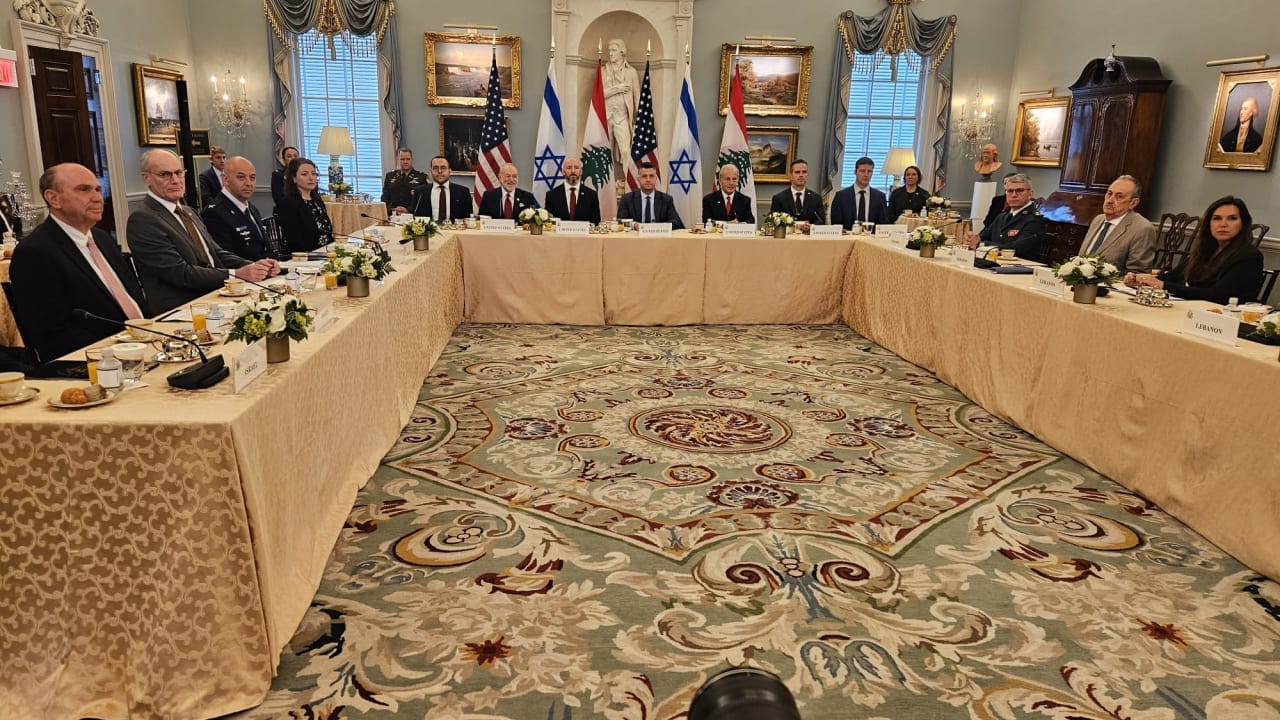
A second day of Israel-Lebanon negotiations began in Washington on Wednesday, a US State Department official told The Jerusalem Post.
According to the official, the goal of the talks is to “continue to advance a comprehensive peace and security between the two countries.”
Present at the talks are an Israeli delegation, headed by Ambassador to the US Yechiel Leiter, and a Lebanese delegation led by Ambassador to the US Nada Hamadeh Maawad, as well as former Lebanese ambassador to Washington, Simon Karam.
One of the main topics of discussion is the pilot program under which the Lebanese Armed Forces would deploy to specific areas in southern Lebanon while the IDF would withdraw from those locations.
Two officials familiar with the discussions told the Post that no significant progress was made during the first day of talks on Tuesday. However, they described the atmosphere as positive and said they expected a joint statement by the end of the talks on Thursday, along with agreements on launching the Lebanese Army pilot program.

The main disagreement between the two sides centers on where the pilot should start.
Lebanon, with US backing, is pushing for the initiative to begin in areas currently occupied by Israeli forces. Israel, meanwhile, prefers to start in parts of southern Lebanon where the IDF is not currently deployed.
“We first need to see whether they can meet the objective and clear the area of Hezbollah’s presence. If that works, the model can also be implemented in areas where the IDF is currently stationed,” an Israeli official told the Post.
Buffer zone between Israel, Lebanon at core of talks, Rubio says
US Secretary of State Marco Rubio told reporters on Wednesday that the disputed buffer zone between Israel and Lebanon is “at the core of” US-mediated negotiations between the two countries.
He said the aim is for the Lebanese government to “continue to be able to control and secure more and more of their own territory.”
“The more of that area the Lebanese armed forces is able to secure, the less of it is in Hezbollah’s control, and the less Israel will be in Lebanon,” Rubio said.
Iranian involvement in Lebanon may complicate negotiations
Two sources familiar with the matter said Iranian involvement in the Lebanese issue, following the memorandum of understanding (MoU) signed between the United States and Iran last week, has complicated the negotiations.
Still, they said both sides are expected to eventually reach an understanding, as Israel and Lebanon both have strong incentives to do so.
“Lebanon has an interest in demonstrating that it does not take orders from Iran and that Tehran does not control Lebanon. Israel, for its part, has no interest in handing Iran any achievements related to Lebanon,” one official said.
Senior Israeli officials continued to insist that there would be no withdrawal from Lebanon.
In attendance at the municipalities conference, MUNI EXPO 2026, in Tel Aviv, Prime Minister Benjamin Netanyahu said, “We will remain there.”
Defense Minister Israel Katz also said that Israel would not withdraw from southern Lebanon even if the US requested it. “Two hundred thousand residents will not return. There are no civilians and no terrorists there. We will not leave the security zones in Syria and Lebanon – this is our security doctrine. The IDF must remain on the enemy’s side of the border and defend Israeli communities from within the territory itself,” he explained.
“Why?” Katz continued. “Because in the past, security zones that included civilian populations became the site of roadside bombs and attacks against our soldiers. We will not allow that to happen again. Soldiers inside, civilians outside. The infrastructure has been destroyed, the houses are damaged and dangerous. We are not withdrawing.”
Israeli, Lebanese delegations encountered sticking points during first day of talks
The fifth round of discussions between the two nations kicked off on Tuesday and focused on the creation of “pilot areas” in southern Lebanon from which IDF troops would withdraw, allowing Lebanese military forces to take their place.
US Ambassador to Lebanon Michael Issa reportedly told Lebanese news outlet Al-Jadeed TV that some difficulties arose on the first day of talks, but added that he hoped the sticking points would be resolved through further discussions.
According to an Axios report on Wednesday, the first day of talks ended with no progress. Two sources briefed on the negotiations told Axios that there was a sense that the discussions resulted in more regression than steps forward.
Before Tuesday’s talks, Leiter had expressed concern regarding the direction of the talks.
“This is the fifth round of talks, and I must say, we are heading toward a train wreck... that train is in danger of derailing,” he said.
Leiter shared his concern that Iran-funded Hezbollah might be given “a new lease on life” under a recently signed US-Iran MoU, warning that it may allow Tehran to continue to funnel resources to the Lebanese terrorist group.
Chance of real agreement between US, Lebanon almost zero, Graham says
US Republican Senator Lindsey Graham told the Shas-affiliated newspaper Haderech that he believes Israel should not withdraw from Lebanon, Maariv reported on Wednesday.
“In my opinion, the chance of a real agreement between Israel and Lebanon is almost zero as long as Iran is negotiating on behalf of Hezbollah with the United States,” said Graham.
I will take a very tough line against any agreement that would be seen as limiting freedom of action with Hezbollah," he added.
Tobias Holcman and James Genn contributed to this report.