
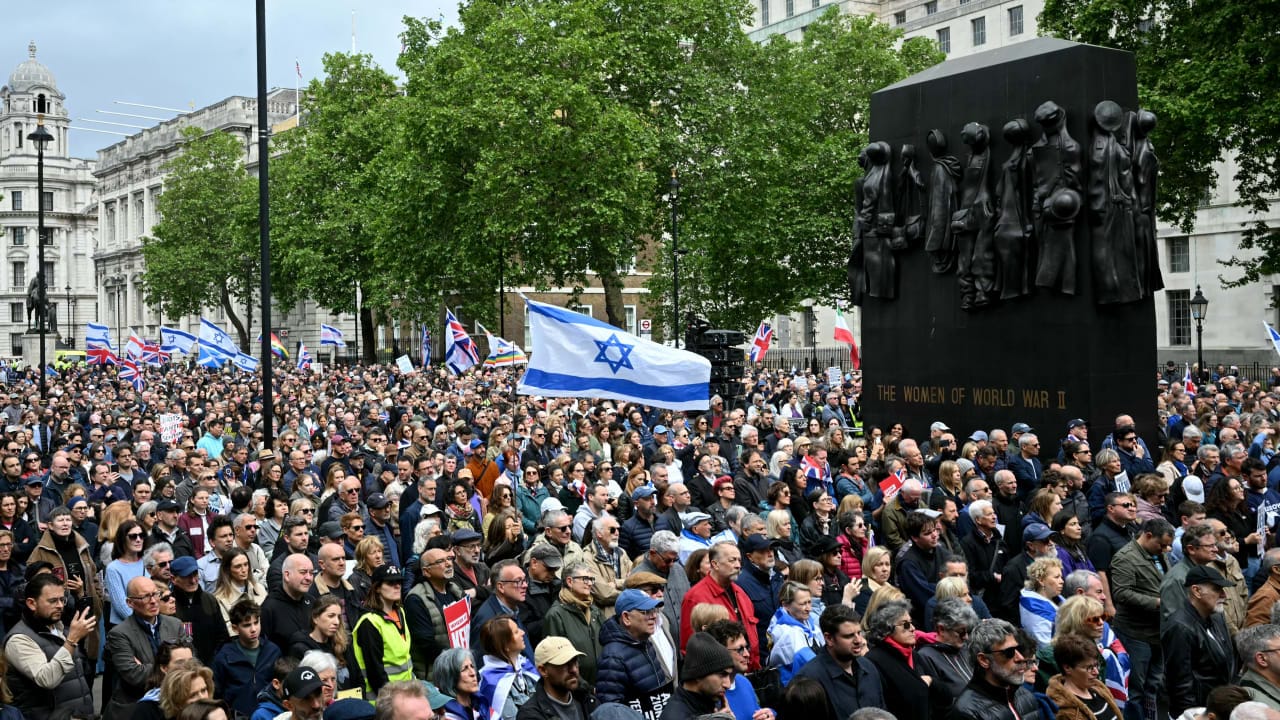

Earlier this year, Britain’s government adviser on terrorism labeled antisemitism a “national security emergency.”
Jonathan Hall KC’s warning followed a series of attacks fueled by anti-Jewish hatred, including a knifeman targeting two Orthodox Jewish men in broad daylight on the streets of Golders Green, a north London suburb with a large Jewish population.
A national emergency
Like many countries, Britain has seen a significant uptick in antisemitism since Hamas launched its murderous assault on Israel on October 7, 2023, triggering the protracted war in Gaza.
Whether or not it is a national emergency, antisemitism has become increasingly difficult to ignore. Last year, the Community Security Trust (CST), a charity providing security advice for Britain’s Jewish community, recorded 3,700 antisemitic incidents, making it the second highest level ever – surpassed only by 2023, which saw 4,298 reports.
There is, of course, one stand-out event: last Yom Kippur, Jihad al-Shamie rammed his car into Manchester’s Heaton Park synagogue before embarking on a stabbing frenzy. Two congregants were killed, and the attacker was shot dead by police.
Figures are not yet available for this year, but the overall picture is expected to be just as bleak. Golders Green has been targeted on more than one occasion this year; in March, three masked men set fire to four ambulances belonging to Hatzola, a volunteer rescue service. Other notable incidents include the attempted firebombing of a synagogue and violent assaults on Jews.
Meanwhile, newspaper headlines regularly report shocking hatred across a range of sectors – from health and education to academia and the arts.
Society divisions
Dave Rich, director of policy at the CST, told The Jerusalem Report that growing divisions in British society are having a far-reaching impact on Britain’s Jews.
“The rise of extremism across the board brings with it heightened antisemitism, whether this is in national politics, on social media, or in the growing belief in conspiracy theories,” he said.
“This plays out across society, which is why we are seeing antisemitism in workplaces, schools, hospitals, and other sectors where it has not previously been a problem. Rather than looking at different sectors individually, it is important to recognize that the role antisemitism plays in all types of extremism makes it a threat to democracy and to society as a whole, not just to Jews,” he added.
Adrian Cohen, senior vice president of the Board of Deputies of British Jews (BoD), said there has been a “step change” since October 7, with antisemitic incidents now “off the scale.”

The way the conflict has been “portrayed in such black and white ways has really poisoned the body politic in society here,” he said.
“So many people who consider themselves liberal and progressive, who only have the vaguest idea of where Israel is or its history, just assume there’s been a genocide. It’s then quite easy to step from that to demonizing a whole community that’s associated with the country that’s allegedly committed the genocide. In that kind of environment, it’s not surprising hate crime is going to flourish,” he added.
Global phenomenon
What has also emerged since October 7, Cohen said, is that antisemitism is not confined to any one country.
“A lot of the issues [faced by Jewish communities worldwide] are very common, particularly because of social media, which doesn’t respect borders. So if you have an influencer like Tucker Carlson spouting controversial stuff in the States, that will come up on people’s algorithms here,” Cohen continued.
“Many of the tropes and the propaganda and the impact of influencers are very common, so therefore increasingly we find ourselves working with our European and other counterparts,” he said.
The BoD, Cohen added, is part of the J7 task force on antisemitism, which brings together the world’s seven largest diaspora Jewish communities under a secretariat provided by the ADL.
The overall picture may be gloomy, but there remain reasons to be positive, according to Cohen. Back in June, the BoD organized the country’s first-ever Jewish Culture Month with over 160 listings, notwithstanding attempts to disrupt one of its events at the British Museum, which was regarded as highly successful. They have now won funding from Arts Council England to build on its success for future years.
“We are a resilient community,” he said, adding that in some ways, the uptick in antisemitism has “deepened the sense of belonging” for British Jews.
Hope for change
Politicians are aware of this and are mostly keen to keep the community on side. In his resignation speech last month, Prime Minister Sir Keir Starmer talked about having “ripped out the poison of antisemitism” from Labour, since he was elected leader in 2020.
There’s no doubt he culled the party of its Corbynite roots, introducing a raft of measures to tackle antisemitism and providing extra funding for community security. His government also designated Palestine Action, a direct action protest group, as a terrorist organization.
Additionally, last month, his government pledged a £251 million funding boost to help police forces across the country provide better protection for Jewish communities.

“The work that Starmer did in tackling antisemitism in the Labour Party after he became leader has receded into the background a bit, but it was hugely significant and is very much to his credit,” said Rich.
“This does not mean that antisemitism has disappeared from Labour completely – there will be people with antisemitic views in every political party – but it is not encouraged or accommodated in the way it was under [Jeremy] Corbyn, which is why so many former Labour members have ended up in the Greens or in Your Party, both of which are now displaying the same types of antisemitism as poisoned Labour during the Corbyn years,” he continued.
For now, the focus is on the mainstream, as the country prepares for a new prime minister – its seventh in 10 years. Starmer’s successor is Andy Burnham, the former mayor of Manchester, a city with the second highest number of Jewish residents.
And yet the community is on tenterhooks, particularly given Burnham’s recent “apology” over his party’s early handling of the Gaza war. Among other things, he said that “the UK was too slow to call for a ceasefire,” and “we’ve got to do more to put pressure on the Israeli government.”
This will have done little to quell Jewish nervousness about the government’s handling of regular anti-Israel hate marches since October 7. Many feel extremism and hatred have been allowed to flourish.
Stephen Silverman, director of investigations and enforcement at the Campaign Against Antisemitism (CAA), told the Report the situation has become “untenable.”
“There are only so many times that you can hear that ‘there is no place for antisemitism in society,’ given that there is clearly plenty of space for it,” he said.
“For years we have been calling on successive governments to stop the hate marches from parading through the streets of our capital. They are ground-zero for the surge in antisemitism that we have been seeing and have disfigured our country. We have made submissions to a review on policing policy; these must be implemented,” he added.
Another priority for the CAA is the “radicalization” of young people in Britain.
“Our polling shows 10% of young people have a favorable view of Hamas, that 14% of them believe it is wrong to class Hamas as terrorists, and almost one fifth – a terrifying 19% – of young people believe that the Hamas attack on Israel on October 7 was justified,” said Silverman.
“There is so much to be done, and one can only hope against hope that with the upcoming change in political leadership comes a change in attitude towards tackling the worst outbreak of the world’s oldest hatred in our lifetimes,” he concluded.■