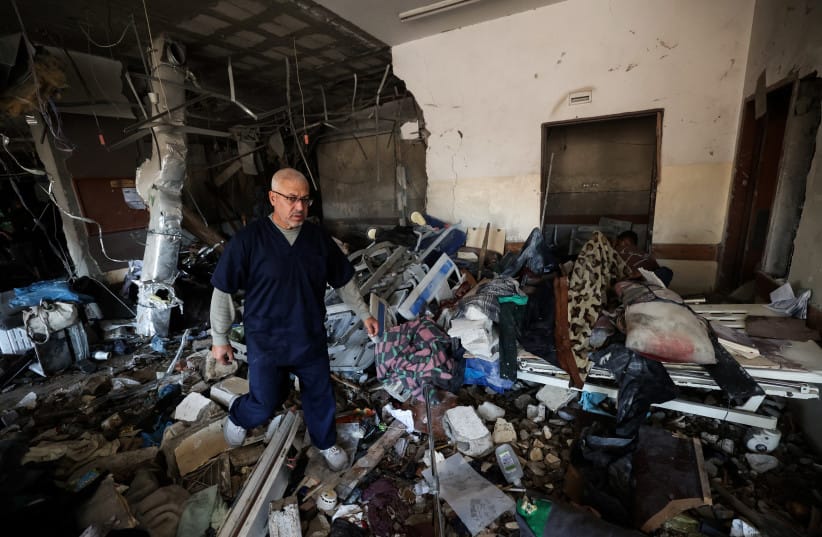
The IDF and Shin Bet (Israel Security Agency) carried out an airstrike against Khan Yunis Brigade commander Muhammad Abu Ismail at Nasser Hospital overnight between Wednesday and Thursday.
The airstrike reportedly killed several and wounded dozens of others, including hospital officials.
Late Thursday, the IDF noted that at least two other senior Hamas officials were killed in the same strike, one in combat engineering and one in operations communications.
It was unclear whether Abu Ismail had survived or not, but there was initially wide speculation over the issue since the IDF did not issue any announcement for around half a day after initial Gazan reports about the attack.
IDF sources whom The Jerusalem Post communicated with did not clarify if the assassination might have been successful, but said that the IDF is conservative about battle damage assessments until it receives all information.
The attack has already ignited global controversy. International patience for Israeli attacks in Gaza – especially involving civilian locations like hospitals – is lower than it has ever been since October 7.
IDF, Shin Bet condemn Hamas's 'cynical exploitation' of hospital
Under international law, Israel has the right to target a terrorist-military official at a hospital. Notably, a number of Gaza hospital officials have worked with Hamas.
For example, the IDF said that the entire second floor had become Hamas’s command center, and access was restricted for regular patients.
But broader questions about international legitimacy are now coming to bear, especially when, technically, a ceasefire has been in place since October 2025.
A few months after the ceasefire, Israel started to act more aggressively against Hamas, saying it could do so as Hamas had refused to disarm, although it refrained from a full invasion of Gaza due to objections from the Trump administration.
Ismail was responsible for overseeing the activities of the terrorists who had formed the brigade, as well as others who were hiding within the hospital compound, the military said.
The IDF said that Ismail was helping plan dozens of terror attacks that would violate the ceasefire, though Hamas has not managed to kill any Israelis in a very long time.
“He was also responsible for holding numerous hostages captive throughout the war,” the IDF stated, without clarifying which hostages Ismail held in custody.
Hamas-linked Gazan media reports claim that six people were killed and at least 28 were wounded in the strike. Likewise, international media has reported claims by the Hamas-linked Gaza Health Ministry that a surgeon and a 13-year-old boy were killed in the strike.
The Associated Press named the surgeon as Dr. Rizk Abu Shaira.
The IDF has not yet announced a specific number of casualties, nor confirmed whether Ismail was killed in the strike.
The strike also came after Hamas terrorists “had established a presence within the hospital complex and used it as a command center for military and terrorist activities against IDF troops and the State of Israel,” the military added.
“Such terror activity constitutes a blatant violation of international law and a cynical exploitation of civilian infrastructure,” the military said, and noted several examples.
These included “storing weapons within the hospital complex, conducting interrogations and torture by Hamas’s internal security and intelligence services within the hospital complex, operating command-and-control rooms within the hospital complex, using hospital facilities as observation posts and shelters for terrorists,” and more, the military said.
The IDF and Shin Bet both strongly condemned Hamas for its “cynical exploitation of civilian and medical infrastructure for military purposes, while endangering the lives of patients, medical personnel, and civilians,” the military confirmed.
The IDF also says it took steps to mitigate any harm to civilians ahead of the airstrike. Mainly, the steps mentioned appeared to be threats of an impending attack on the hospital officials if they did not expel Hamas, including a last warning not long before the strike.
Hospital director claims facility rendered unusable in 'Al Jazeera' interview
According to the AP, drawing from local reports, the strike hit the hospital’s surgical wing.
The AP quoted the director after the strike, who said, “No warning came before the attack.” He also said that surgeries had been suspended because of the extent of the damage.
In August of last year, the IDF shelled the Nasser Hospital, killing 20 people. Six were confirmed by the IDF to be Hamas terrorists.
The attack sparked controversy and demands for an investigation into the matter, with criticism mostly circling the imprecise method of tank shelling and the decision-making process that led up to it.
The order to fire was allegedly given without knowing for sure whether Hamas forces occupied the building. The IDF admitted that the decision behind the attack was a mistake.
On March 24, 2025, the IDF and Shin Bet put out a statement that they had killed Ismail Barhoum, head of Hamas’s finances and institutions, with the terrorist group’s political bureau during a strike in Khan Yunis in southern Gaza.
The senior Hamas official was the successor of Issam al-Da’alis, the former Hamas prime minister who was killed only around 72 hours earlier.
Avi Ashkenazi, Amit Avitan, and Jonah Davidov contributed to this report.