
The British government has announced plans to designate Iran’s Islamic Revolutionary Guard Corps (IRGC) under new national security powers, subject to parliamentary approval later this week.
Ministers fast-tracked the National (State Threats) Bill 2026 as promised by outgoing Prime Minister Keir Starmer.
The existing legislation of the Terrorism Act 2000, which provides for the proscription of terror groups, did not extend to state-backed groups. The new bill amends the National Security Act 2023, enabling the designation of state-backed groups (which is identical to proscription, although legally different).
Home Secretary Shabana Mahmood concluded that there is sufficient evidence to reasonably believe all three organizations are engaged in foreign power threat activity and that designating them is necessary to protect the UK’s safety and national interests.
“I have rapidly designated three groups so those working for them will be tracked down and put behind bars,” she said.
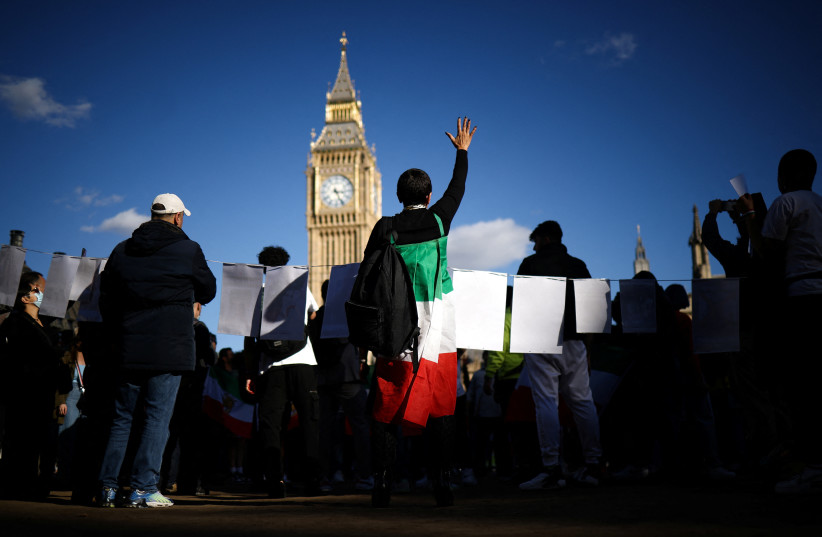
Fight must continue against IRGC network
As well as the IRGC, the two other organizations that the UK is designating are: The Islamic Movement of Companions of the Right (IMCR), an Iran-linked militant group also known as Ashab al-Yamin (HAYI); and the GRU Volunteer Corps (GRU VC), a network of Russian volunteer and proxy formations overseen by Russia’s military intelligence agency (GRU).
IMCR claimed responsibility for seven attacks against Jewish communities, journalists, and Israeli-linked targets in the UK and Europe between March and May 2026, including the antisemitic arson attack on four Hatzola ambulances in Golders Green.
Now that the home secretary has designated the bodies and laid the regulations, the designations must gain approval from both Houses of Parliament.
If this happens, it will become a criminal offense to invite support for, or express an opinion or belief supportive of, the IRGC, IMCR, and GRUVC; assist them in carrying out UK-related activities or engage in conduct likely to materially assist it; or accept or retain a material benefit provided by or on behalf of them.
These offenses could carry sentences of up to 14-years in prison.
“We will never let Britain be a playground for hostile states who want to spread fear, division and violence on our streets,” Starmer said.
“We have already taken tough action against the Iranian regime and those linked to it, and against Russian operatives and networks targeting our country. These new powers will make it easier to prosecute and lock up anyone carrying out their dirty work here in Britain,” he said.
“That is not a decision to celebrate without asking why it took this long, but it is the right one, and I welcome it,” Roger Macmillan, a former director of the Iranian diaspora site Iran International, told The Jerusalem Post.
“Proscribing the IRGC is the floor, not the ceiling,” he said. The real fight now is against the network around it: the front charities, the so-called Islamic centers and education centers that launder its ideology into British communities, the online broadcasters and the social media influencers who do Tehran’s work for it. None of that stops because one organization has been added to a schedule.”
Macmillan said proscription of the IRGC must now be matched with the political will and resources to support the police forces and the security services to actively go after networks and bring people to justice, “not just designate an organization on paper.”
“Today is the right first step, many years too late. The hard work starts now,” he said.