
The announcement came with the kind of quiet confidence that characterizes Israel's defense industry at its most assured. On May 26, Elbit Systems reported that its order backlog had crossed $30 billion for the first time in the company's history, a figure that would have seemed implausible even five years ago.
Buried inside that same disclosure was a single contract worth $1.4 billion, signed with an unnamed European state, covering multi-domain military modernization across land, air, and electronic warfare capabilities. No press conference. No ceremony. Just another line item in a record-breaking ledger.
The timing is striking because it lands against the backdrop of a sustained, and frequently loud, European political campaign to restrict, shame, and in some cases formally exclude Israeli defense companies from the continent's procurement ecosystem.
Spain suspended arms exports. Several NATO member governments have floated partial embargoes. Elbit itself was expelled from Euronaval, France's premier maritime defense exhibition, after protests and political pressure. The message from European capitals, at least the public-facing version, has been one of distance and moral condemnation.
The message from European defense ministries has been the opposite.
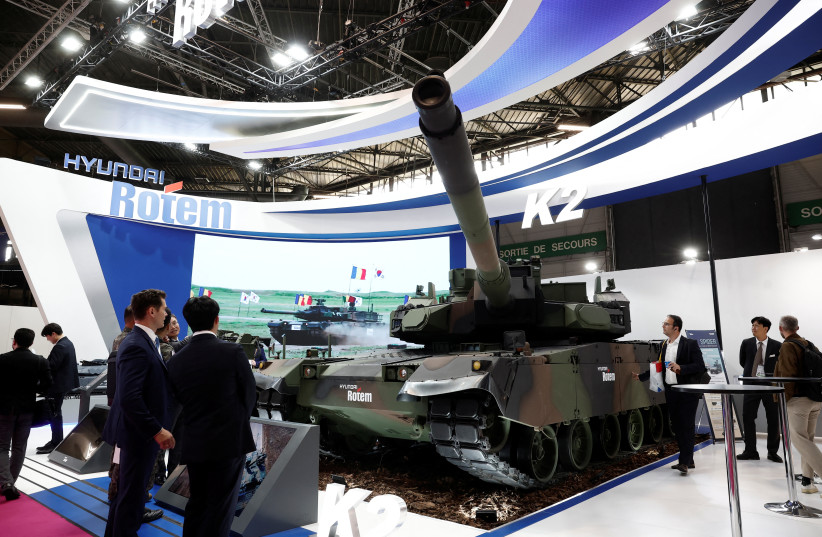
European armies trying to modernize
This contradiction is not incidental. It reflects a structural reality that no amount of parliamentary rhetoric can dissolve: European armed forces are in the midst of a generational modernization push, driven by the war in Ukraine and the sudden collapse of the post-Cold War security consensus, and Israeli defense technology sits at the center of what they need most urgently.
The gap between what European politicians say and what European procurement officials sign is a measure of how dependent the continent's security architecture has become on Israeli innovation.
The technology at the core of this dependency is not glamorous in the way that fighter jets or naval destroyers tend to be. It is, instead, the layered infrastructure of modern battlefield connectivity.
Software-defined radios, which allow militaries to communicate securely across disparate systems and reconfigure frequency bands in real time, have become a priority for every NATO member attempting to integrate legacy platforms with next-generation command networks.
Elbit's BNET systems have become effectively the default solution for European armies that need battlefield interoperability without waiting a decade for a domestically developed alternative to clear bureaucratic and industrial hurdles.
The same logic applies to electronic warfare suites, where Israeli firms have developed active, adaptive capabilities shaped by operational experience that no European laboratory can replicate by design alone.
That phrase, "operational experience," is the central variable that no European defense contractor can manufacture on schedule. Israel's defense industrial base does not produce systems for theoretical threat scenarios.
It produces systems that have been used, broken, revised, and redeployed under live combat conditions across multiple domains and adversary types. When a European defense ministry examines an Israeli electronic warfare package, it is not evaluating a prototype or a concept demonstrator. It is evaluating something that has been stress-tested in environments more demanding than anything NATO's eastern flank has yet produced.
Europe's own defense programs are not without ambition. The continent has spent years discussing the need for strategic autonomy in defense, and major collaborative programs in armor, aviation, and artillery have advanced in fits and starts.
But the word that consistently appears in evaluations of European defense procurement is "slow." Industrial coordination between member states, procurement bureaucracies calibrated for peacetime timelines, and political interference in contracting decisions have produced programs that frequently take 15 years to deliver what the threat environment requires in three. Against that backdrop, a proven Israeli system available on accelerated delivery terms is not a second choice. It is the rational one.
Israel's ability to meet that delivery expectation is itself a function of a manufacturing transformation that has unfolded largely outside European public view. Elbit and its peers have invested heavily in automated production lines, robotics integration, and AI-assisted quality control inside their domestic facilities.
The result is a production model that is considerably less vulnerable to the labor shortages and supply-chain bottlenecks that have plagued European defense manufacturers over the past two years.
When a European country signs a multi-billion-dollar modernization contract with an Israeli firm, it is not simply buying technology. It is buying certainty of delivery in an environment where that certainty has become increasingly scarce.
What the $30 billion backlog represents, then, is not simply commercial success. It is a verdict delivered by the procurement agencies of some of the world's most sophisticated militaries on which defense industrial base is currently producing the most operationally relevant, deliverable, and cost-effective capabilities on the market.
European politicians retain the power to hold press conferences and vote on symbolic resolutions. European generals, it turns out, retain the power to sign contracts. For now, the generals are winning the argument.
Amine Ayoub, a fellow at the Middle East Forum, is a policy analyst and writer based in Morocco. Follow him on X: @amineayoubx