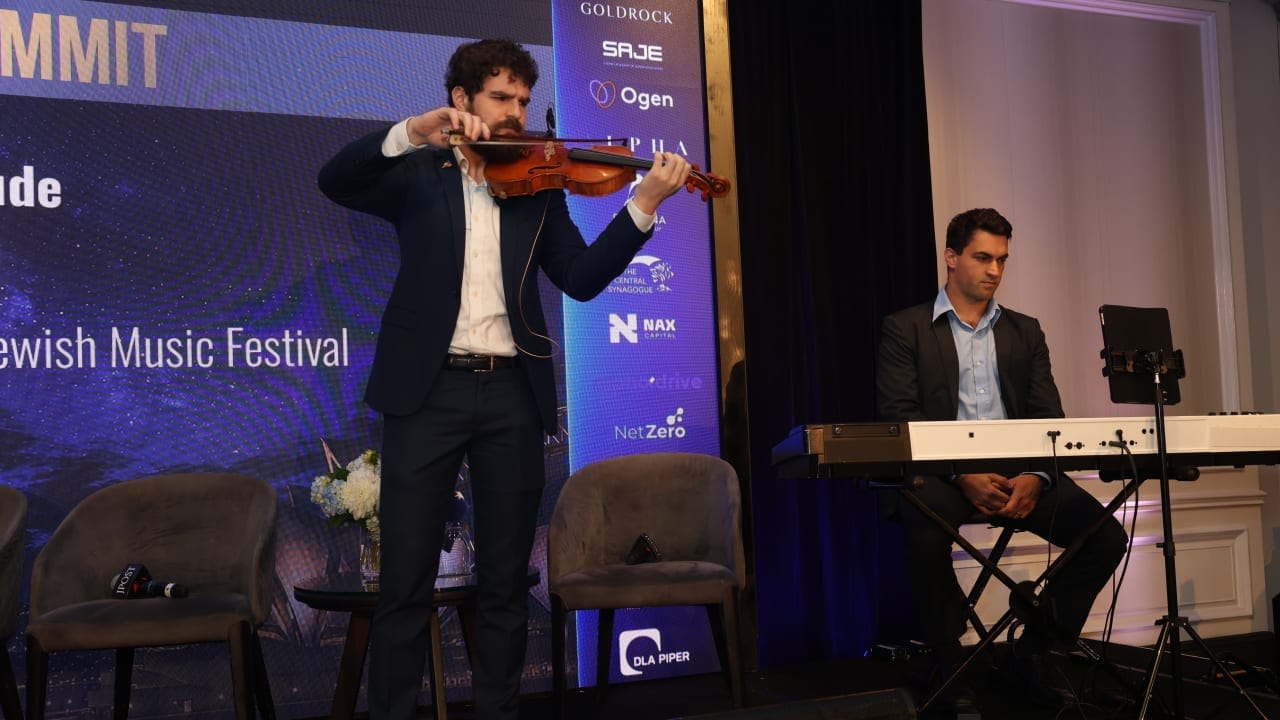
The answer to antisemitism is not for Jews to retreat from public life, but to make their culture, identity and traditions more visible, Australian musician and festival director Ben Adler told The Jerusalem Post.
"We believe the answer to antisemitism is not retreating from Jewish life. It's living Jewish life openly, proudly, and confidently," Adler said at The Jerusalem Post Australia Summit in Sydney on Thursday.
As director of Sheer, Australia's national Jewish music festival, and a violinist who leads the band Chutney, Adler has spent his career bringing Jewish music to wider audiences. Since October 7, however, he says that mission has become increasingly challenging, with Jewish artists facing growing reluctance from cultural institutions to give them a platform.
Adler described a growing reluctance among festival directors, radio stations, grants panels, award committees and arts administrators to associate themselves with Jewish artists and openly Zionist performers.
About a month after October 7, a festival director who had previously offered his band a major platform called to withdraw the invitation.
"I'm really sorry, but things are awkward now," she told him, citing the "complicated situation overseas."
Adler said it became clear that the concern was not the music itself, but the possibility of protests or criticism from anti-Zionist activists. Following several conversations, the festival ultimately reinstated the performance.
"What I've found is that much of the cancellation comes not from people who personally believe Israel is evil, but from people who fear the consequences of being associated with Jewish artists," he said.
Security has also become a major consideration for Sheer, which has held three festivals in Sydney and two in Melbourne since October 7. Organizers have had to coordinate with police, private security providers and the Community Security Group while weighing whether events can be publicized and their locations disclosed.
One incident particularly affected Adler. Shortly after the Bondi attack, in which one of his friends was killed, Sheer was invited to perform a musical tribute during Australia Day Live.
Having previously experienced threats, including a Molotov cocktail threat directed at one of the festival's Melbourne events, Adler alerted organizers and the New South Wales government, expecting additional protective measures.
Instead, he was told the group could perform only if its involvement remained secret.
"You can perform, but nobody can know about it," he recalled.
The decision forced Sheer to withdraw promotional material, photography arrangements and publicity plans.
"That was probably the lowest point for me," Adler said. "People wanted to stand with Jews because Jews had been murdered. Yet when it came time to publicly support a Jewish cultural performance, the government didn't have the courage to stand behind us."
For Adler, the experience reflected a broader sense of abandonment by institutions he had previously assumed protected all Australians equally.
He has also seen divisions emerge within the Jewish artistic community. While some performers have become more visible and outspoken about their Jewish identity, others have withdrawn out of concern for their careers, with some reluctant to appear on stage, be filmed or be identified publicly with Jewish cultural projects.
Nevertheless, Adler said Sheer has also helped him build relationships with artists from outside the mainstream arts establishment, including Indian, Muslim, Christian Islanders and Iranian performers.
Among those who have offered support is Michael McDonald, a descendant of Indigenous Australian leader William Cooper, who famously organized a protest against Kristallnacht. McDonald opened Sheer's Opera House concert with remarks supporting the Jewish community.
"People like Michael give me hope," Adler said.
This year, Sheer’s festival brought more than 2,200 people to the Sydney Opera House for a sold-out performance featuring artists from diverse backgrounds. One Iranian Muslim performer even sang the Shema and "Shalom Aleichem" alongside the ensemble.
"We're trying to show something larger than a concert. We're trying to show what genuine cultural exchange and coexistence can look like," he said.
Rather than allowing the challenges facing Jewish artists to dictate the future of the festival, Adler is focused on expanding its reach. Following its Sydney success, Sheer is heading to Perth, continuing its efforts to create spaces where Jewish culture can be celebrated alongside the traditions of other communities.
"We're trying to create moments of celebration, creativity, and confidence," he said.
For him, Sheer's mission has two central goals: strengthening Jewish communal life and building stronger relationships between the Jewish community and wider Australian society.
"Music creates relationships that political arguments often cannot," he said.