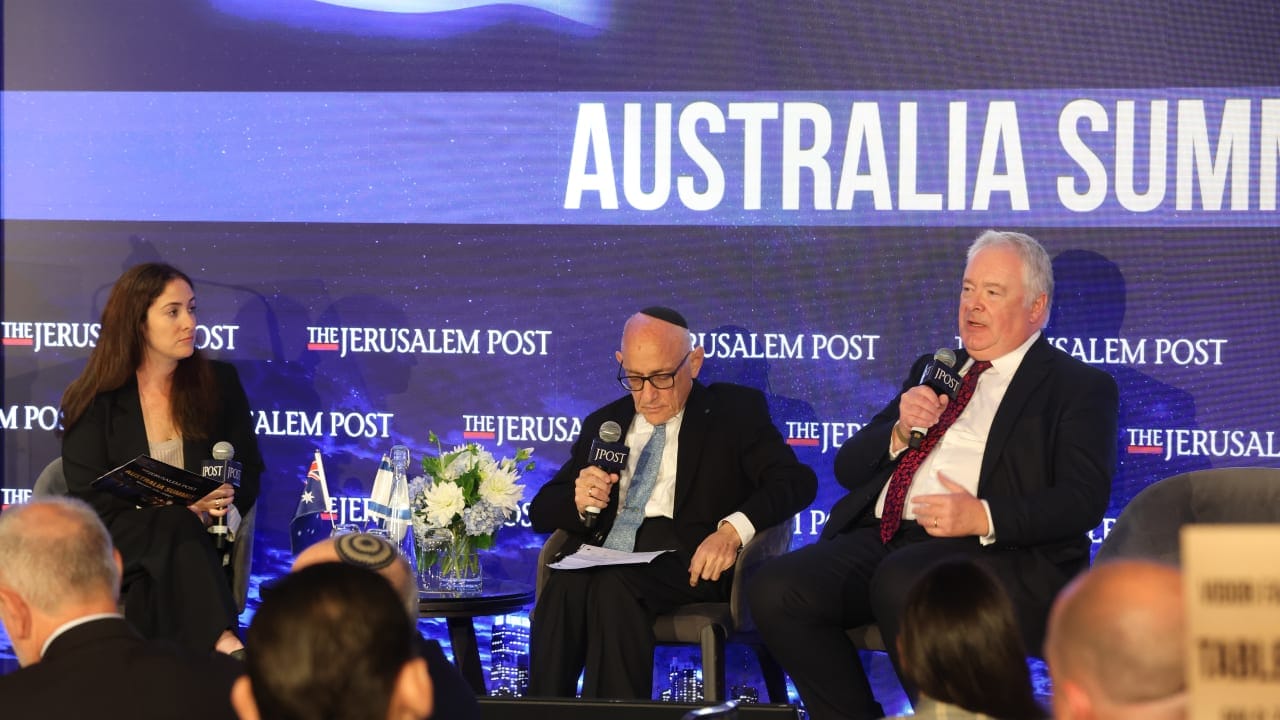
Iran’s continued missile and nuclear ambitions and the growing possibility of a Chinese military move against Taiwan underscore the need for Israel and Australia to rethink their defense strategies, security experts warned at The Jerusalem Post Summit in Australia.
Speaking during a discussion titled “A World in Disorder,” Brig.-Gen. (Res.) Professor Jacob Nagel, Senior Fellow, Foundation for the Defense of Democracies; Former Head, Israel's National Security Council outlined three possible scenarios for Tehran: returning to negotiations, escalating attacks against American interests in the Gulf, or attempting to withstand continued US economic pressure in the hope of a political shift in Washington.
Despite Israeli strikes against Iranian military infrastructure, missile capabilities and personnel, Nagel warned that Tehran continued to pose a significant threat to the Jewish State. He also pointed to the Strait of Hormuz as a major strategic vulnerability, given its importance to global energy supplies and trade.
The warnings come amid escalating tensions in both regions. On November 17, US fighter jets struck an Islamic Revolutionary Guard Corps missile-launch site on Iran’s Qeshm Island, near the strategically important Strait of Hormuz, following Iranian attacks against US personnel and assets in the Gulf.
The discussion also turned to China, with Peter Jennings AO PSM, Executive Director, Peter Jennings Strategy Consultants Pty Ltd. estimating a 50% chance Beijing could contemplate military action against Taiwan between 2027 and 2028.
Such a confrontation might begin with a blockade rather than a direct invasion, he said, warning that any conflict could quickly spread across the Indo-Pacific and draw Australia into a wider regional war.
Jennings’ assessment comes as China has intensified military activity around Taiwan, with large-scale naval and coast guard deployments and exercises raising concerns about Beijing’s ability to impose a blockade.
Both Nagel and Jennings argued that the evolving threats required militaries to accelerate the adoption of emerging technologies, including artificial intelligence, autonomous systems, hypersonic weapons and directed-energy capabilities.
Nagel said the next military revolution would be driven by AI-enabled maneuvering and robotics, alongside the growing use of inexpensive drones deployed in large numbers to overwhelm enemy defenses.
He also highlighted high-power microwave technology as a potential solution to the growing challenge of drone swarms, arguing that expensive interceptors alone would not provide a sustainable answer.
Jennings, meanwhile, criticized Canberra’s defense investment priorities, saying too much funding was being committed to systems that could take a decade to enter service, while only around 1% of defense investment was directed toward autonomous systems and AI.
“Frankly, I just don’t think we’re well placed,” he said, adding that Australia could learn from Israel’s ability to adapt quickly and develop capabilities in response to emerging threats.