
In a wide-ranging conversation, Dassault Systèmes Israel Country Manager Eli Boichis reflects on the shift from physical to virtual validation, the true role of AI in robotics, and why the "boring parts" of engineering are ripe for revolution.
On most mornings the invisible work of advanced machinery is already on the breakfast table. “You eat yogurt that was mixed, poured and sealed by machines. Nobody stands there and checks every cup, there are entire systems ensuring it works.” This is Eli Boichis’ go-to reminder that advanced technology doesn’t belong in the far future - it had been shaping our lives for decades.

For the past 11 years, Boichis has led Dassault Systèmes Israel, the local branch of the global science-based company that powers, designs, engineers, handles simulations, and manufactures across industries. During that time, he has watched companies navigate the growing gap between technological capability and industrial adoption. “The innovation is already happening around us, he says. “But adoption, especially in traditional engineering, has its own pace.”
From Aerospace Heritage to the 3DEXPERIENCE Platform
Yet, this drive for innovation is grounded in a legacy of precision. This uncompromising standard of accuracy is rooted in the company’s history.
Boichis traces Dassault Systèmes’ origins back to its aerospace roots. “The company began in 1981 with 20 engineers supporting the aerospace industry. Today, more than 25,000 employees are driven by a shared passion, to prove how the virtual worlds can improve real life.” He explains exactly how that heritage informs the company’s unrelenting dedication to precision. “The engineers grew up in aerospace,” he says. “When your background is designing fighter jets, anything less than 100% accuracy is unacceptable.” Dassault Systèmes today is a catalyst for sustainable, game-changing human progress.
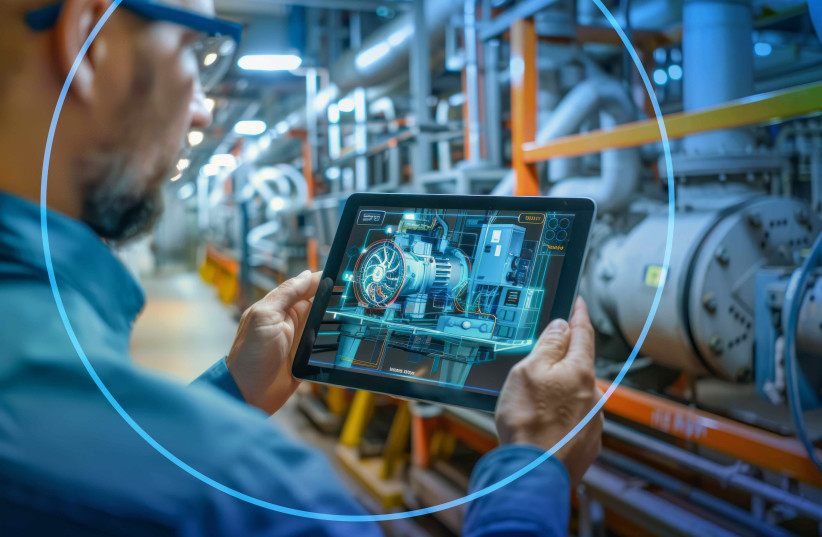
This pursuit of precision is the engine behind the 3DEXPERIENCE platform, a cloud-based collaborative environment that centralizes data and tools. “One platform, all the data in one place,” Boichis explains. “Requirement management, system engineering, CAD, simulation and manufacturing all running in the same managed environment.” The payoff? A near-seamless transition from concept to a scientifically accurate Virtual Twin Experience.
It isn’t just about creating a static 3D image,” Boichis clarifies. “We embed real-world physics' materials and loads into the digital model from the very first sketch.” This is made possible because the platform unifies design, simulation, and manufacturing on a single data model. “Whether you are a mechanical engineer or a simulation expert, you are working on the same living asset,” he says. “The result is a science-based representation, that behaves just like the physical product, allowing companies to validate complex systems virtually, drastically reducing the need for costly physical prototypes.”
“This is exactly how today’s leading companies conceptualize and build everything—from an autonomous electric car or a high-speed train to a smartphone or a Bluetooth speaker,” Boichis adds. “They rely on this scientific foundation to sprint from an abstract concept to a fully validated product in the market.
The virtual crash test: Precision in action
“There are some who don’t believe just how accurate virtual testing has become,” he smiles. “Take a new car’s crash test for example. In the past, you had to crash multiple physical prototypes to get data. Now, when you watch a virtual crash test on our platform the folding metal, the movement of the dummy manikin, the airbag’s behavior - when you compare it to the physical test, they behave almost identically. Of course,” he notes, “you still have to crash an actual car, but you’ll be doing so knowing what to expect.”
“We are effectively neutralizing potential failures early in the process. This isn’t just about efficiency; it is about sustainability—saving materials, energy, and waste by getting it right the first time, in the virtual world.”
The Virtual Companion
Boichis is often asked whether artificial intelligence will replace engineers, and his answer - drawn from a recent factory visit - is quick to follow. “There’s a robotic arm, then next to it a worker stretching upholstery over a car seat,” he says. “A robot can weld, it can lift, it can tighten bolts - but it can’t smooth wrinkles in that fabric, not yet at least. AI and robots won’t replace the engineers,” he laughs, “they’ll just take care of the boring parts.”
Working on cloud with 3DEXPERIENCE platform, AI acts as a virtual companion. “AI,” Boichis clarifies “learns from repetitive tasks done a thousand times, later when faced with a similar challenge, it can suggest or guide the designer.” Nevertheless, we must draw a clear boundary around intellectual property.
That being said, he describes virtual assistance that pops up during design work with reminders about the need to comply to specific standards, safety regulations, or machine specifications. His excitement is unmistakable, “It doesn't just automate tasks; it guides the engineer through the maze of global compliance. Engineers will no longer need to look up or remember every American or European regulation they have to comply with by heart,” he says. “Why should they? The assistant would ensure the required compliancy is respected."
The cloud’s on the march
If AI is the shiny part of the story, cloud adoption (a must for real AI) is the stubborn one. “Most engineers still work on a workstation they keep under their desk,” Boichis says. “The reality is: cloud is coming, but slowly.” The culprit is history - decades of legacy data & tools that companies find challenging to migrate to the cloud.
“Big companies carry a huge amount of ”baggage”, decades of legacy data” he says. “Everything they do today is built on work done for many years.” It is interesting to see startups with no legacy systems easily moving to work on the cloud. “Meanwhile, large manufacturers that stand to massively gain from AI move forward slowly, but as Boichis asserts “migration at their scale could take years.”
Looking ahead: Evolution, not science fiction
Pressed to imagine the next three or five years, he resists sensational predictions. “More accuracy, more automation, more intelligence built into the tools. Not science fiction,” he asserts, “just a better version of what already works.”
Boichis claims that the next phase is simply extending that model across more domains, and while it might sound modest, he insists it’s transformative. “If I were you,” he says “I’d take an AI course today. Learn to build tools that help you. Writers, engineers, accountants - everyone will have helpers or agents, not to replace them, but as I said, just to remove the tedious parts.”
Concluding our conversation, an optimist Boichis sums up Dassault Systèmes’ mission simply: “We save people from the heavy lifting. The tools do hard, repetitive work. Humans do the meaningful parts. That’s the future. Good things are worth waiting for,” he smiles. “You’ll see them change the world.”
Written in collaboration with Dassault Systèmes’